


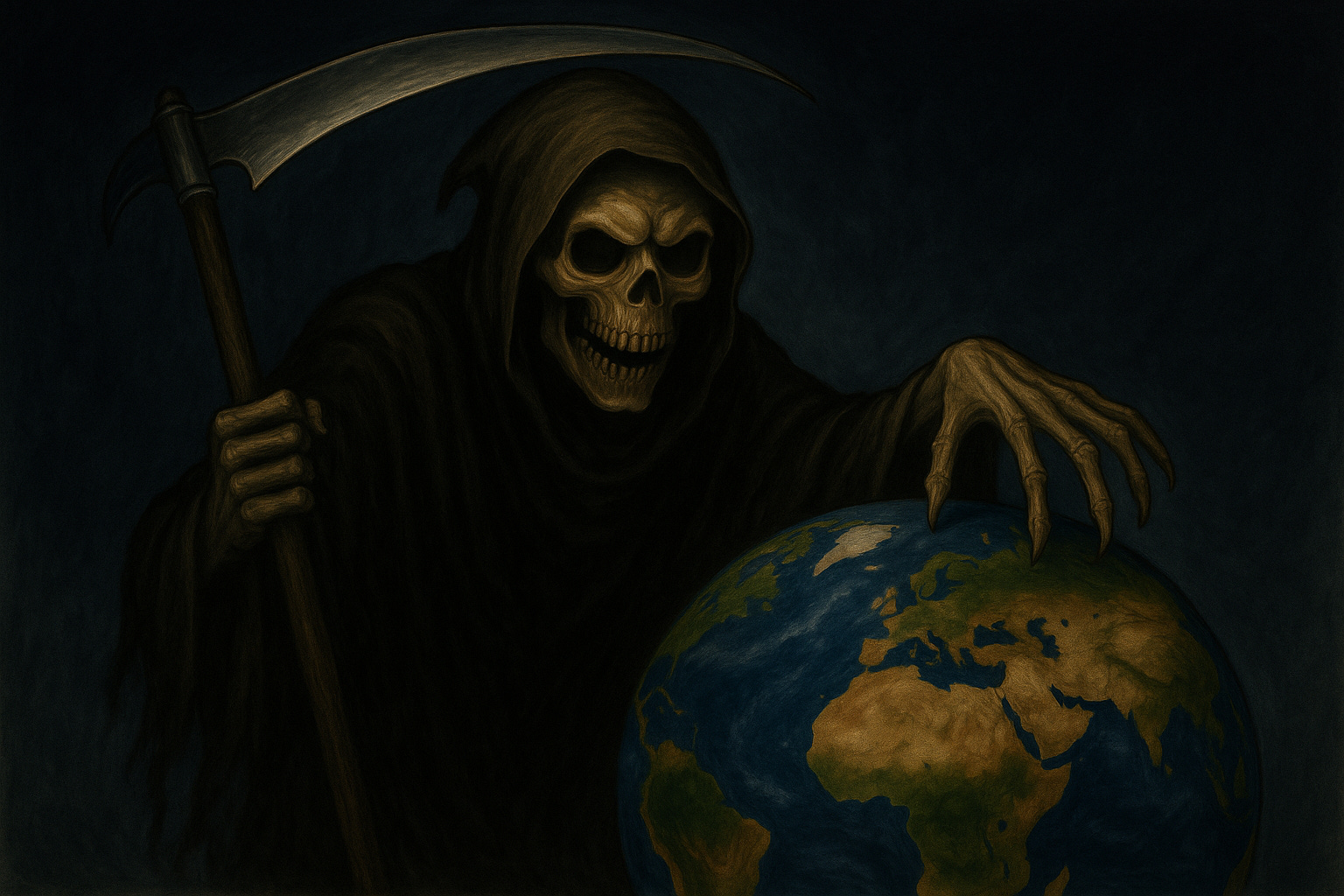
If you were old enough to watch television in 1987 you will remember the Grim Reaper AIDS advertisement. It ranks as the most memorable, most successful and maybe most dishonest Australian government ad ever screened.
It begins with an ominous fog on an empty screen. The silence is broken by a metallic clash that echoes like the hammers of hell, followed by a satanic growl from the blackened teeth in the skull of the Grim Reaper. His empty eye sockets framed by his sackcloth cowl stare down the length of a demonic bowling alley. At the other end, 10 people are lowered through the mist to stand rigid like bowling pins as a foreboding male voice intones: “At first, only gays and IV drug users were being killed by AIDS.”
Those who remember the 1980s will recall the fear caused by the spread of AIDS. It came into sharp focus for me in 1985 when it killed Hollywood leading man Rock Hudson. Then some of my friends died. So nothing that follows should be read as an argument that Australia should not have acted to curtail the spread of the disease or that anyone’s sexual orientation reduces the value of their life.
But there is no doubt that when the ad was released those behind it knew the disease mostly affected men who had anal sex and injecting drug users. In 1987, the actual number of diagnosed HIV cases in Australia was in the low thousands and the frightening figures in the script were fanciful.
The rationale behind the campaign was understandable. The federal health minister at the time, Neal Blewett, and his senior adviser, Bill Bowtell, feared the community would not be moved if it believed the only groups at real risk were gay men and drug users.
The idea was to universalise the threat to control the politics of the response and deliver the funding they needed for the fight.
Fear is a great motivator and the campaign was a thumping success. Its defenders would point to Australia’s internationally low infection rate as proof of concept, and they may well be right. Success spawned many other campaigns that leaned on the same strategy.
That does not change the fact this ad was deliberate government disinformation. The excuse is it was lying for a greater public good. The idea of the noble lie traces its roots all the way back to Plato’s Republic, where he argues rulers may propagate a myth or falsehood for the sake of social harmony or to protect the state.
The problem with lying is it’s a bad habit no matter how good the cause, and fear campaigns create imaginary monsters that can be difficult to control.
There is no bigger fear campaign in human history than global warming. Many would argue there is every reason to be terrified. I can’t recall what The Guardian’s index reads at the moment but I think it is dialled up to emergency and every claim of catastrophe from any quarter is met with unquestioning assent.
This column’s position is that climate change is a problem but not an existential threat. Rich countries will manage adaptation better than poor ones, and adaptation is where this lands because global emissions keep rising. The world is not serious about net zero so over-investing in mitigation is a mug’s game if many are cheating.
Clearly, the Albanese government honestly believes global warming is a real and present danger that demands a radical overhaul of our energy systems.
It’s also clear that the raft of documents it released to support its 2035 emissions reductions targets are littered with deliberate sins of omission and commission, all made in the noble cause of stoking alarm to save the planet.
Its risk assessment report is a masterclass in distorting information to strike terror into the hearts of the population. And the government and its agencies are just the tip of an industrial-scale network of publicly and privately funded advocates, and a long vapour trail of activists all busily stoking the furnaces of fear.
Much of the education system has spent the better part of this century ensuring kiddies develop a healthy dose of climate anxiety. It has been so successful that some say they don’t want to bring children on to this burning platform of a planet.
So, congratulations one and all, you have bequeathed to your children the paralysis of despair.
There is one other big problem with the permanent climate horror show: the wind and solar-dependent electricity system the government is bent on building can’t work without gas. It will cost billions and barely function with bucketloads of gas. But thanks to the yeoman spadework of the Greens, the teals, Climate Change and Energy Minister Chris Bowen and Labor’s Environment Action Network, many see gas as Satan’s syrup.
Never forget, Bowen told the COP28 climate change jamboree: “We need to end the use of fossil fuels in our energy systems. We can’t compromise on the science or the need to act. Words can be flexible, but we need outcomes. Fossil fuels have no ongoing role to play in our energy system. And I say this as the Climate and Energy Minister as one of the largest fossil fuel exporters in the world.”
Bowen’s career is testimony to his belief that words are flexible but, alas, ordinary people believe words mean something. The government turned those words into legislated emissions cuts. Now it must find a way to walk those words back across ground it has already salted.
So it was refreshing to hear from two Labor premiers this week who, unlike anyone in the federal government, speak clearly and actually have to run electricity systems.
South Australia’s Peter Malinauskas and NSW’s Chris Minns are signed up to decarbonisation but both highlight the centrality of gas in underpinning that project. Both also admit that more wind and solar do not add up to cheaper electricity, as everyone’s electricity bill proves. The only thing that will bring down bills is access to abundant, cheap gas, and the only road to that is increasing supply.
My mother liked to say, “Oh what a tangled web we weave when first we practise to deceive.” It was a way of reminding her children that lies have a life of their own and keeping your story straight in a tangle of deceit is hard. In government, lies don’t just risk tripping up the liar; they corrode trust in every institution that repeats them. Once people learn they’ve been misled, they don’t forget and they don’t forgive. Trust, once squandered, is rarely restored.
It’s like a disease.
The catastrophists cite rising temperatures in equatorial countries and expanding desertification in the Sahara as evidence for the climate change hypothesis. The exceptionalism from normal trends is difficult to prove. For generalists, we are asked to believe that a marginal increase in atmospheric CO2 is sufficient to overwhelm the massive energy stream from the sun and related earth orbital variations that determine the planet’s climate. Hubris on a global scale that will depreciate for some time the reputations of the scientists and modellers who proclaim this fantasy. Meanwhile, the economic loss caused by massive investments in unprofitable ‘renewable’ power supplies will be substantial, and, of course, damage most the people with little discretionary income to pay the higher taxes and energy bills needed to support these grotesque blots on the natural landscape. The renewable supporters seem to have adopted the strategy of the proverbial general in Vietnam: we had to destroy the village in order to save it. The climate scare will go down in history as the madness of a culture in decline.
Popular delusions and the madness of crowds.