



“Charity is injurious unless it helps the recipient to become independent of it.” - John D. Rockefeller
We need to recognise our current taxation redistribution system has become a charity. To end the dependency, Australia needs to adopt competitive federalism. It really is that simple.
Sadly, the present taxation set-up rewards failure and punishes success. The only logical way to stop the proliferation of public sector employment, avoid plunging productivity, and end fiscal irresponsibility is to transfer more taxation power to the states and let them compete — and therefore be accountable — for their own backyard.
Before jumping into a strong case for competitive federalism in Australia, analysing the interstate rivalry of four US states — Florida, Texas, New York, and California — provides great context.
Let’s jump right in.
It should come as little surprise that the most cited factor for corporations in the US migrating to other states is the business climate (aka lower taxes). Both Florida and Texas have zero state income tax. California levies 13.3 percent. New York charges 7.25 percent, but if operating inside New York City (NYC) a further 8.85 percent is added, with a Metropolitan Transportation Authority (MTA) surcharge of 2.175 percent if operating inside the metro area. Cheaper energy and access to skilled labour are also seen as critical levers. Florida and Texas have both.
California’s renewable energy obsession puts the price of industrial electricity at four times the national average, as transmission congestion, grid modernisation charges, and other state-mandated fees are added. Texas has the cheapest industrial electricity prices — hence why many energy-intensive tech companies choose it.
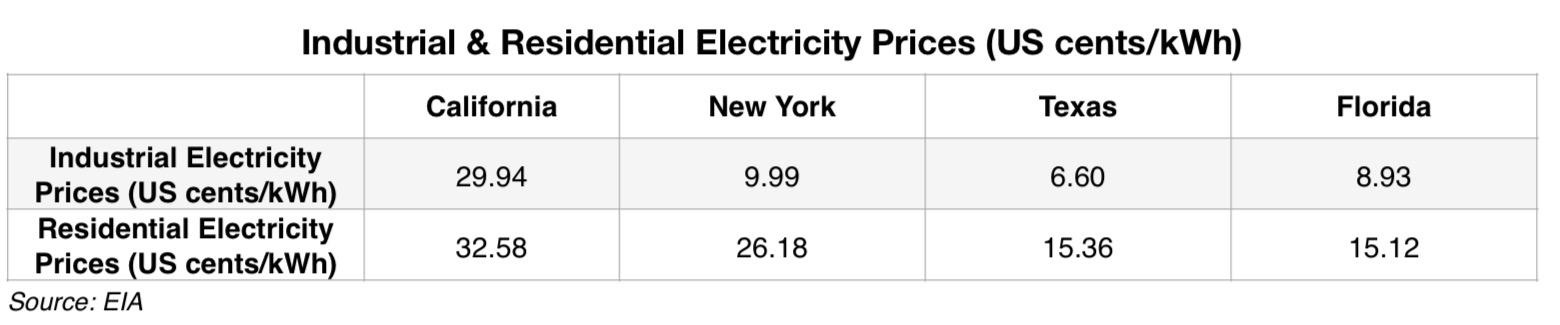
Alas, net corporate migration to Texas and Florida since the pandemic has followed this trend.

Major corporate headquarter moves from California to Texas include Tesla, SpaceX, Chevron, Oracle, and Hewlett Packard Enterprise. Many financial institutions from New York are moving to Florida, including sizeable parts of a name synonymous with Wall Street, Goldman Sachs.
Cumulative gross state product (GSP) growth over the previous five years reveals Florida and Texas growing at around twice the national average.

Florida’s unemployment rate of 3.8 percent is well below California’s 5.5 percent and the national rate of 4.3 percent.
Analysing Net Tax-Supported Debt (NTSD) as a percent of GSP, Florida ranks first (i.e. best) in the nation, with Texas fifth out of the fifty states.
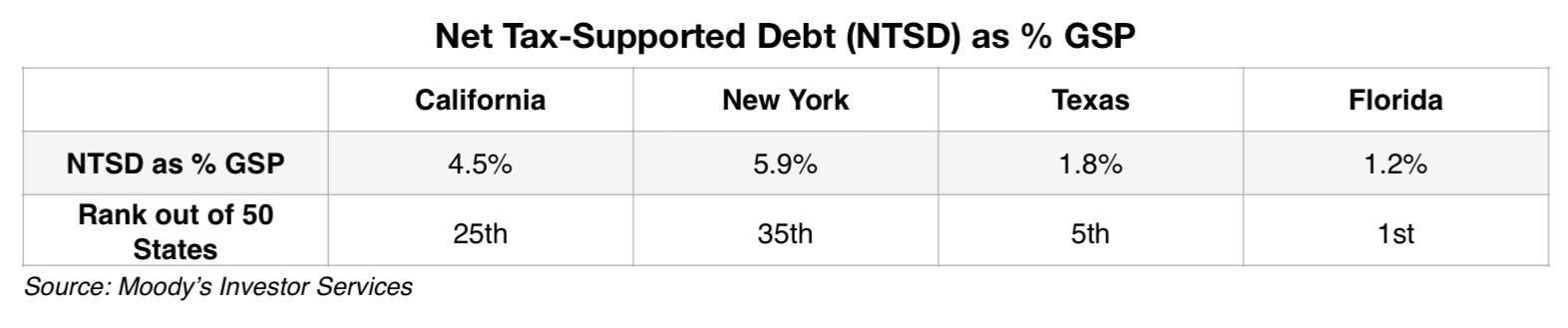
These data sets are not exhaustive by any means, but the empirical evidence shows that the states which proactively attract businesses are the ones succeeding. Net migration figures naturally reflect these opportunities. California ranks dead last. Florida first. Texas second. Quod erat demonstrandum (Q.E.D.).

To incentivise newcomers, Florida has adopted a state-administered Quick Response Training grant program, which allows employers to customise training directly to the needs of the required roles. Four hundred thousand employees have been eligible. Compare that with free TAFE courses in Australia, where students learn skills irrespective of whether they are directly applicable to prospective employer needs.
Texas provides 10-year, 50 percent property tax abatements for businesses that hire people in the state. A further 25 percent is offered for setting up businesses in opportunity zones.
California and New York provide incentive programs but are handicapped by slow permitting and complex regulations.
Which brings us back to Australia.
The following table lists the ratio of GST redistribution determined by the Commonwealth Grants Commission over the past two decades. Naturally, a score of less than 1.0 means a state pays in more than it gets back, and vice versa for scores above 1.0.
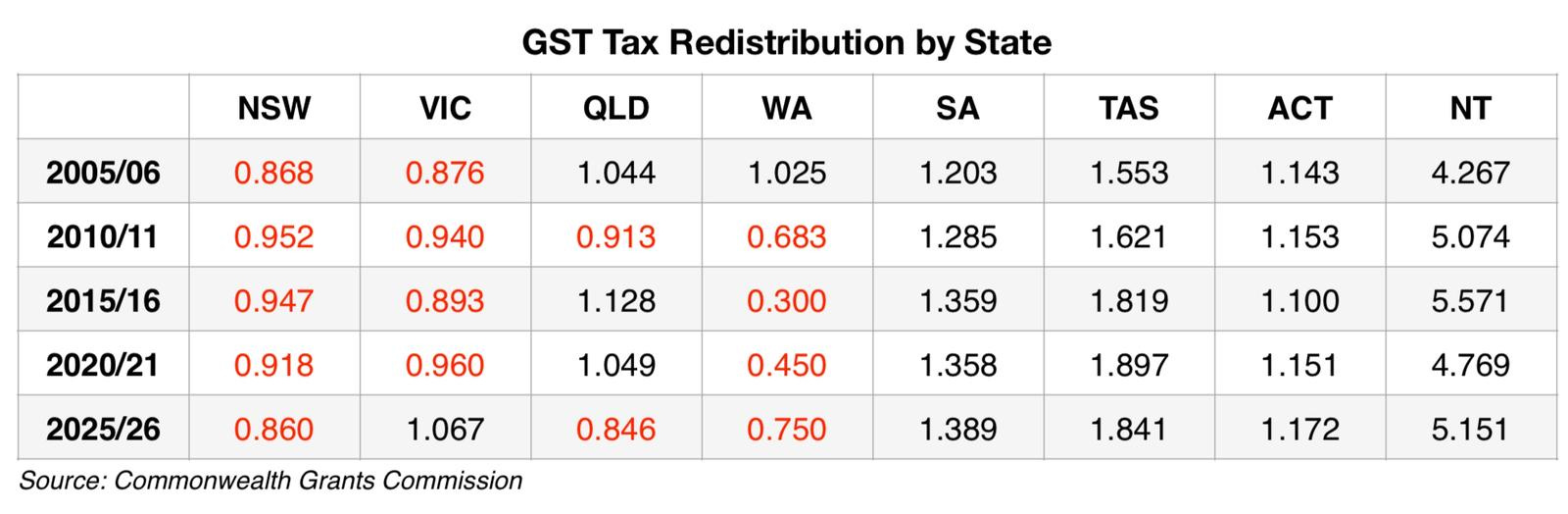
Victoria has recently become a net beneficiary of the tax redistribution. Cynically, one might say the mendicant state has finally fulfilled its socialist utopia of being able to spend other people’s money.
Our federal government collects about 80 percent of all tax revenue and distributes about 50 percent. As a percentage of state or territorial tax revenues — defined by the Goods & Services Tax (GST) or Specific Purpose Payments (SPP) — federal tax redistribution is as follows.
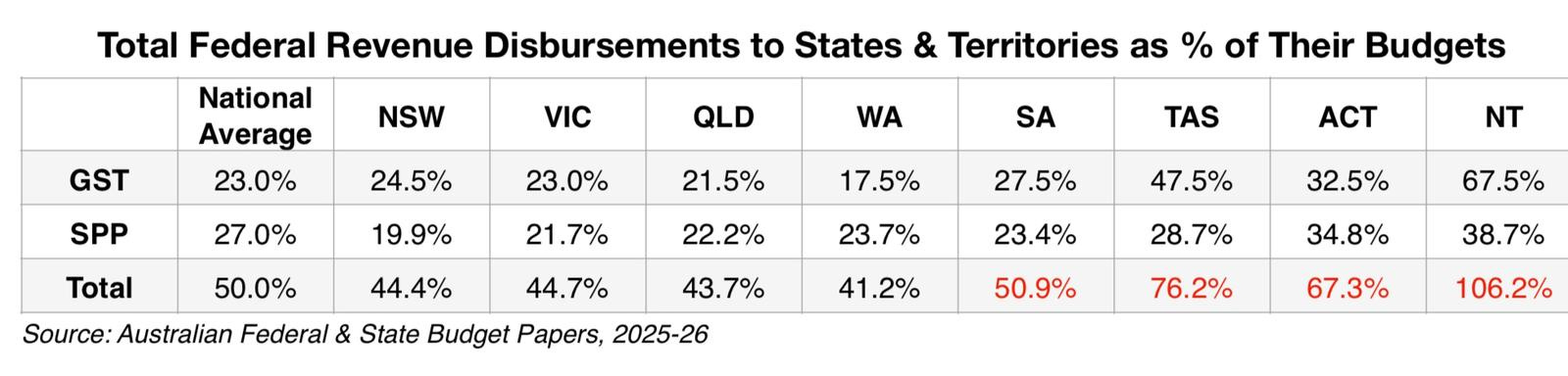
In short, South Australia, Tasmania, and the territories derive over half their revenues from Canberra. What is the incentive to push for budget efficiency?
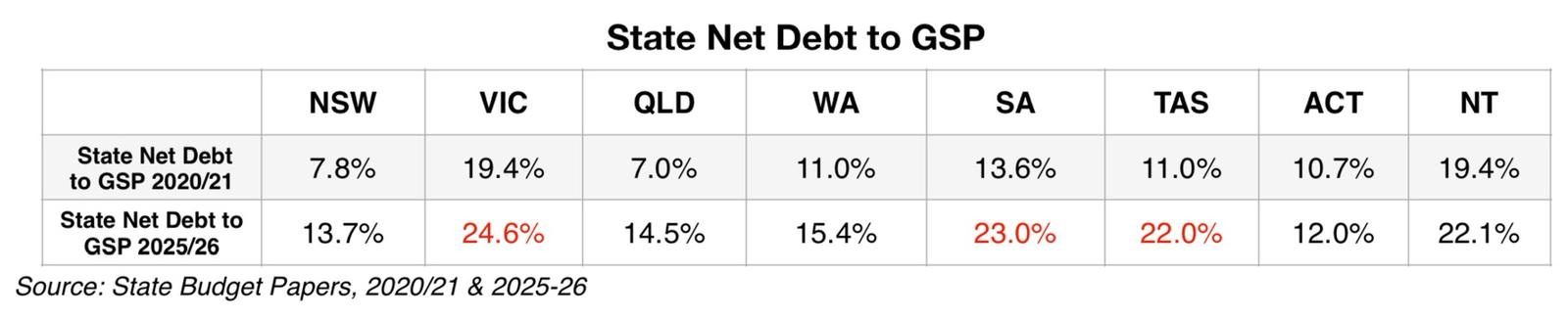
A cursory study of net state debt to GSP reveals a relatively tight correlation between poor fiscal management — namely Victoria, South Australia, and Tasmania — and redistribution.
Three-quarters of budget revenue in Tasmania is courtesy of federal funding. It generates $20,000 less GSP per capita than NSW, but this green utopia gets rewarded for being less attractive to private enterprise.
South Australia gets 51 percent of its full-cream budgetary milk from the Canberra teat. Easy money, especially with sweeteners such as the $2.4 billion Whyalla steelworks bailout thrown in.
Not to be outdone, Victoria likes to be first. It holds the world record for the longest lockdown during the pandemic, owns our largest state debt levels, highest tax burden, most onerous regulations, and lowest credit rating. Is it any wonder when signature projects such as the Southern Rail Loop, originally earmarked as a $50 billion investment, are now forecast to cost over $216 billion? This is not an isolated incident.
If we had competitive federalism, perhaps Victorian bureaucracies would be held accountable by the voters for such fiscal ineptitude. Then again, if Victorian Treasurer Jaclyn Symes, upon her appointment, directed her staff to “stop using economic terms,” one supposes the one-eyed bureaucrat becomes the default king in the land of the blind in Melbourne.
Excessive red tape has meant Victoria suffered a net loss of 3,254 businesses to other states since the pandemic. The Institute of Public Affairs (IPA) noted that in 2024 alone, 129,000 Victorian businesses closed. A total of 82,130 Victorians migrated to other states, compounding business challenges. Conversely, Queensland and Western Australia have seen net interstate migration of 125,000 and 45,000 respectively.
Should we be surprised to learn that almost 90 percent of new jobs in Victoria since the pandemic are either in the public service or derived from government funding? Tasmania’s public sector is aggressively making up for the decline in private sector employment, with almost 114 percent of jobs created by government (by deduction, to cover the rapidly shrinking private sector).

If we wanted to put this labour market insanity into context, studying the minefield of regulations and licences required to operate a café in Australia takes some beating. Tasmania and Victoria require over 35 different pieces of bureaucratic paperwork to be submitted.

While hygiene, food, and fire safety are to be expected, why does it take up to 12 months for a business wanting to sell cappuccinos and avocado toast to legally open? In Victoria’s case, the Business Council of Australia (BCA) noted that multiple council departments and state government agencies — including VicRoads, the Environmental Protection Authority (EPA) Victoria, and Melbourne Water — had their fingers in the pie of approvals. Assuming one passes the requirements, many costly annual renewals are required. It is nothing short of business-stifling overreach.
Why are companies slugged with state payroll taxes on top of egregious penalty rates, GST, income tax, and every other conceivable levy? How can our government investment agencies brazenly spruik to domestic and international investors that we are open for business?
During meetings with senior executives from major Japanese and Korean industrial giants over the last month, energy prices were the number one issue detracting from investment in Australia. They are already frustrated enough by our lack of policy predictability.

Without cheap energy, Australia faces a bleak future. Domestic investment is stagnating at levels not seen since the 1990s recession. Productivity is at six-decade lows, along with falling living standards not seen since the 1950s.
In a post-pandemic world, our economic growth performance remains anaemic.
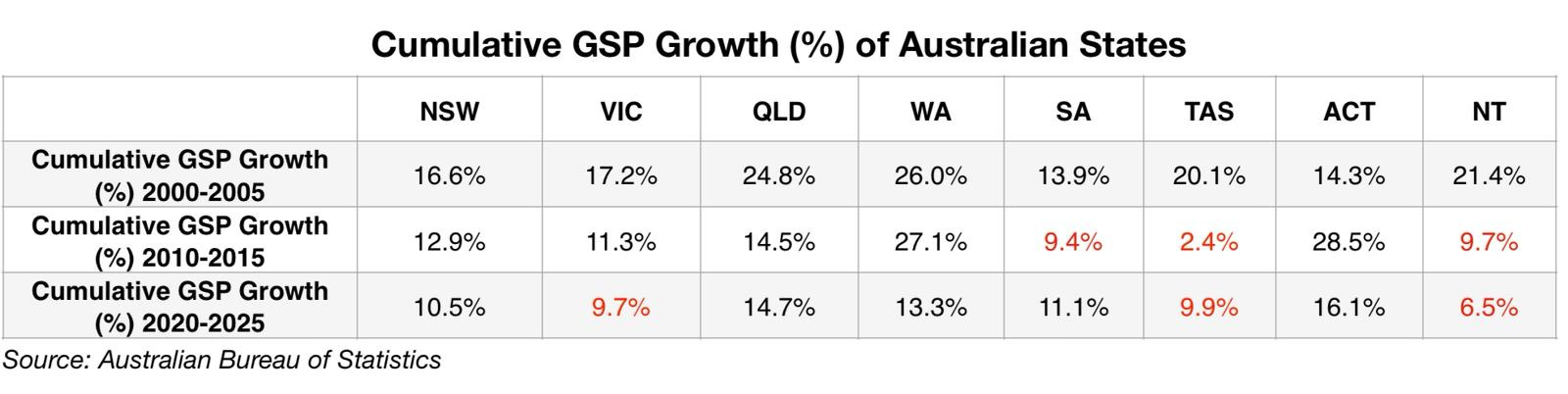
Could our fall from 16th (middle of the pack) among the Organisation for Economic Co-operation and Development’s (OECD) taxation burden ranking in 2000 to 29th (the bottom quartile) in 2025 be behind this underperformance?
Or could it be our excessive regulatory frameworks confounding our ability to grow, especially in crucial industries such as mining?
New South Wales (NSW) Minister for Resources, Courtney Houssos MP, is out there telling investors, “There has never been a better time to invest in mining in NSW,” but how much faith can she put in peddling departmental platitudes if they do not reconcile with being ranked behind Zimbabwe, the Democratic Republic of the Congo (DRC), and the Ivory Coast for investment attractiveness?

The same negative trend is seen in the Fraser Institute’s Global Policy Perception Index. New South Wales (NSW) and Victoria have fallen behind Ghana and Turkey. It is an embarrassment for a once-proud mining jurisdiction.
Perhaps we might ask why BMA coal operations in Queensland are losing $1 million per day funding the egregious Queensland coal royalties, paying an effective 67 percent marginal tax. Or Bowen Coking Coal, which recently went into administration because it had to pay $120 million in royalties to the government before it ever turned a profit.

While our government might be clinking champagne glasses on the back of the critical minerals deal with the United States (US), American corporates and government agencies will be faced with the same hurdles when they consider feasibility studies, let alone final investment decisions. Our system is deeply unpopular and globally acknowledged as such. We must stop kidding ourselves.
Having worked inside government, the problem is crystal clear: our federal and state bureaucracies think of themselves as the clients, and all are there to serve them. If we continue to believe that customer ignorance is a profit centre, we will continue to fall behind. The feeling of safety and comfort zones comes with the complacency bred by decades of believing our prosperity is not earned but a birthright.
In order to make competitive federalism effective, state governments would have to adopt a complete change in mindset, requiring the widespread replacement of many senior career bureaucrats with experienced private sector executives in touch with market drivers and the incentives that would send the right signals of strategic intent to investors. Chevron, BHP, Rio Tinto, and JERA are the latest examples of companies telling us enough is enough.
Unless we reform our tax code, we will continue to waste opportunities to global jurisdictions hungry for investment. Capital has never been as global, and those states that believe lining up every year with cap in hand, relying on the benevolence of the federal treasury as a sustainable long-term strategy, will eventually discover they will all run out of other people’s money.
We must seriously consider splitting income tax into federal and state components to reverse the inefficiencies inherent in the current system. Federal taxes would be used to fund defence, national security, foreign affairs, certain aspects of healthcare, the judicial system, and treasury. The states could then competitively set their own income tax thresholds to attract domestic and international capital. States should keep the Goods and Services Tax (GST) raised and take responsibility for infrastructure, health, education, energy, and business attraction. Why do we have federal departments of education, trade, or health when their primary function is to disperse federal funds to the states? Needless duplication.
In summary, competitive federalism would go a long way toward restoring the prosperity that is being squandered by the current self-serving structures.

Rafe, indeed our industrial relations laws are growing ever more inflexible. Soon, they take
Another turn making it even harder to restructure.
Totally agree I used to specialise in corporate law economics and brought Roberta Romano from Yale Law to ANU to help argue that states retain responsibility for corporate law. Almost no one was interested. As a result corporate law is now exponentially greater in volume as are the public servants to run it. The law is so complex that only highly paid professionals understand it. Probably a major reason for the decline in productivity in Australia. Ian Mcewin formerly of ANU Law