


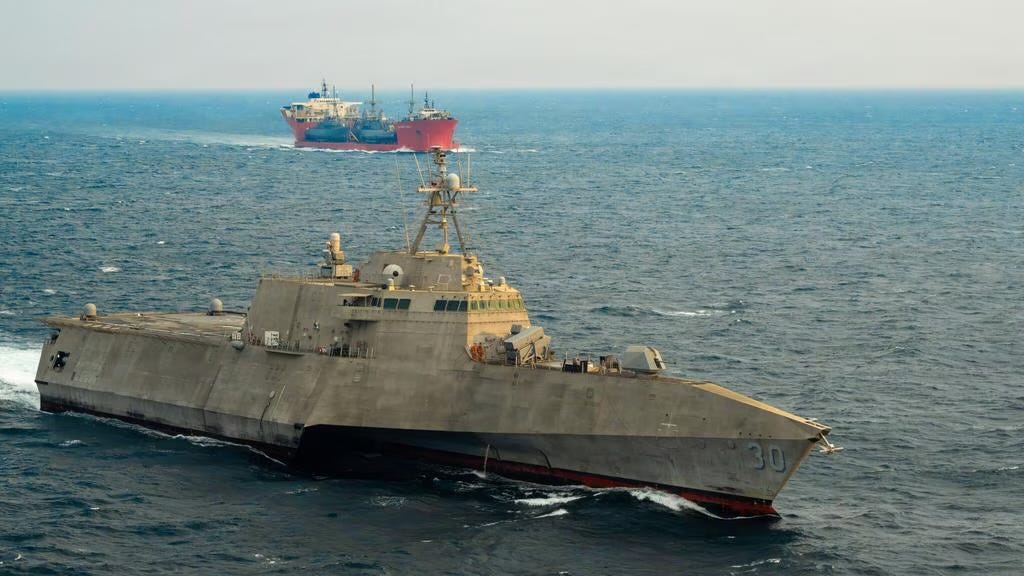
In January, the Pentagon released an image of the USS Canberra escorting a massive cargo ship carrying four ageing US Navy Avenger-class minesweepers out of the Persian Gulf.
The wood and fibreglass vessels were beginning a long journey to a scrapyard in Philadelphia after being retired from service with the Bahrain-based US Fifth Fleet last year.
American minesweepers have been patrolling the waterways of the Gulf since tankers were targeted during the Iran-Iraq war in the 1980s. But as the Cold War peace dividend was cashed in, de-mining slipped down the Pentagon’s priorities. Mine Warfare Command was dismantled in 2006 and its ageing fleet was left to atrophy in a corner of the US Navy that had no real champion.
The picture of the minesweepers’ departure, just before the shooting started in the third Gulf War, is pregnant with meaning. Most immediately, it reveals Operation Epic Fury as an epic failure of timing, judgment and strategic imagination.
Days after the war began, Iran laid mines in the Strait of Hormuz, disrupted the world’s most vital artery and sent shockwaves through the global economy. The presence of the minesweepers was testimony to the fact the US had understood this risk for 40 years. Donald Trump chose to ignore it.
A New York Times article co-authored by its Australian-born and bred White House reporter, Jonathan Swan, revealed this week that the US President was convinced any war with Iran would be swift and decisive. He was already leaning into that view before Israeli Prime Minister Benjamin Netanyahu arrived in the White House Situation Room on February 11 to argue that Iran was ripe for regime change and that a joint US-Israeli mission could topple the Islamic Republic.
The next day Trump’s advisers gathered without their Israeli counterparts to caution the President against the notion of a quick and clean victory. CIA director John Ratcliffe is reported to have described the regime change scenarios as farcical. Secretary of State Marco Rubio weighed in, saying, “In other words, it’s bullshit.”
Chairman of the Joint Chiefs of Staff General Dan Caine warned that a major campaign against Iran would drastically deplete American weapons stockpiles. He also flagged the enormous difficulty of securing the Strait of Hormuz and the risk that Iran would attempt to block it.
Those who believe Trump enjoys a kind of secular papal infallibility will dismiss this report because of the masthead that printed it. The counter is that Swan has been remarkably good at his craft for a long time and the report rings true because the concerns raised are exactly what anyone paying even modest attention to the region, its history and its geography would have concluded.
Someone also might have added that the enduring feature of American military campaigns since Vietnam has been the difficulty of converting overwhelming tactical superiority into lasting strategic success.
Once Trump would have volunteered this view. One of the reasons so many war-weary Americans were drawn to him was his pledge to end the forever wars. In 2020 he told a group of West Point graduates it was not the job of American forces “to solve ancient conflicts in faraway lands that many people have not even heard of”.
Since last year’s 12-day warm-up in Iran and the assault on Venezuela, it is as if the President had discovered a new key he believed could unlock all doors. It must be intoxicating to have the power to rain destruction on your enemies but, alas, not all have the same motivation. Some don’t do earthly deals. The threat of death does not work on people who believe martyrdom is a glorious gateway to eternal life.
Those of us who love life are left to grapple with how best to deal with navigating the realities of this world. And earthly concerns have been rapidly reordered around the planet.
That is why there is a far deeper meaning buried in the image of ageing American minesweepers being led out of the Persian Gulf by a ship bearing the name of our capital. It speaks to something difficult to capture in words other than epoch defining.
This was a funeral procession for a world order Australia’s leaders assumed would endure. It is a photograph taken at the hinge of history, capturing not just the retirement of a class of ships but the crumbling of an empire of ideas. The old order has been discarded, largely through a wilful act of vandalism by the President of the nation that built and defended it.
Unfortunately, Australia built its modern economy on that order. That bet is now a busted flush. The only certainty from here is that the times will suit us less well. So, we need to deal with the world as it is, not as we hope it might be.
In the shadow of the US security guarantee, we built an island nation that could outsource most of the goods it needs to survive. We grew things, dug things up and sold them for export cash that crashed on to our shores in ever larger waves as commodity prices rose with the spectacular rise of China.
We slowly unlearned how to make things as manufacturing was shipped offshore. In its place we built supply chains that circled the globe and delivered cheap imports. We grew rich and became complacent as inflation fell and the job losses that come with recessions passed out of memory.
It was in that era that one of the most liquid fuel-dependent countries on Earth mostly stopped producing oil, shut down domestic refining and became addicted to imports. We dismantled our buffers and discarded resilience as inefficiency.
We barely contemplated the idea that the world beyond our shores might not always be open, stable and benign. We organised our economy around a just-in-time delivery in a world where, one day, times were bound to turn. Which is why, when the system failed, the shock was immediate and elemental.
We are now scrounging around the world for shipments of fuel at any price. What matters now is how we respond. We need a short, medium and long-term plan for securing our energy independence. It will not be cheap or easy but the cost of not doing it could not be written more starkly and there are opportunities for a country with Australia’s deep energy endowment.
In tailoring our response, we should watch what the world is doing as it confronts the same crisis.
With a fifth of the world’s oil and gas disrupted by war, a vast hydrocarbon hole has opened in the global economy. Countries are scrambling to fill it. Governments are turning to what they can control. Thermal coal prices have climbed from around $US110 a tonne earlier this year to about $US130 to $US140, as gas disruptions in Asia force utilities to switch fuel.
Coal-fired plants that were meant to close are being kept open. Others are being run harder. Japan is increasing coal-fired generation to conserve gas. South Korea has lifted caps on coal output. India has ordered its coal fleet to run flat out. The Philippines, Bangladesh, Pakistan and Thailand are doing the same. Italy has postponed the closure of its coal-fired plants for more than a decade. Germany, once the wind and solar standard bearer and now twice mugged by the real world, is beating a strategic retreat. Chancellor Friedrich Merz has warned that if this crisis endures, Berlin may have to keep coal-fired power plants running longer than planned.
“We have to supply this country with electricity,” Merz said. “I am not prepared to jeopardise the core of our industry just because we have decided on phase-out plans that have become unrealistic.”
At a conference in Texas Berlin’s Energy Minister Katherina Reiche said the EU should loosen its “rigid” adherence to climate neutrality and allow itself to miss its 2050 net-zero goal.
Reiche stressed that economic growth must come before green targets.
“At the end of the day, it is good to have a goal of sustainability – but if sustainability crashes your economy, you have to readjust,” Reiche said. “And that’s what we’re doing right now.”
In Europe, the price of carbon has fallen since the war began. The system designed to penalise emissions is under pressure to release more permits and soften its constraints. The price of emitting is being lowered just as the incentive to emit is rising.
Decisions taken under stress tell you a lot. Energy security is a must-have. Cutting carbon is an adornment.
The markets are sending the same signal. Oil moves with every presidential utterance, but the more important story lies further down the chain. Diesel, petrol and jet fuel are what move trucks, ships, planes and armies, and they are rising faster than crude. With the interruption to the oil supply and the worldwide scramble for fuels those costs will stay high even if the passage through the Strait of Hormuz is cleared.
In bond markets, the cost of money is climbing. Governments are paying more to borrow as energy, inflation and risk are repriced together. They are also preparing to spend more to cushion the shock, pushing long-term borrowing costs higher still. The cost of keeping the system running is rising at the same time as the system itself becomes more uncertain.
Put these signals together and a pattern emerges. When the system is stressed, it behaves as built and the house hydrocarbons built still runs on coal, oil and gas.
That reality should shape Australia’s response. We should use every resource at our disposal to secure our independence in liquid fuels and all other sources of power. We should be truly energy agnostic. Coal, gas, oil, uranium, wind, solar and batteries all have a role to play and we should aim to become an energy superpower.
The Gulf states understood this decades ago. They did not just extract hydrocarbons. They built the industries that flow from them, from plastics to fertilisers, from petrochemicals to pharmaceuticals. They captured value across the entire chain.
Australia could do the same. We could power energy-intensive industries. We could host the data centres that will drive the next wave of artificial intelligence. We could secure our own future while helping to fill the hydrocarbon deficit now emerging in the global system.
That requires a shift in thinking. It requires us to see energy not as a carbon-emitting liability to be managed but as a strategic asset to be developed. The lesson from this crisis is that security is essential and energy security underpins economic and national security. No fuel, no future.
A ship bearing the name Canberra escorting the last minesweepers out of the Gulf is a snapshot of an era when the world was governed by American power and a network of alliances.
That era has passed. Now we endeavour to chart our own future or live in a world where hostile states determine it for us. We are not powerless unless we choose to ignore the power beneath our feet.
This article was first published in The Australian
Great essay once again Chris.
It reminds me of the Mark Twain quote, ‘Two things are infinite: the universe and human stupidity; and I’m not sure about the universe.’
Rephrased: ‘Two things are in ample abundance in Australia fossil fuels and human stupidity; and in the latter super-abundant!!
The call for energy agnosticism is right, but the gap between aspiration and execution is enormous. Across critical minerals and gas in WA and Queensland, average permitting timelines for major projects have blown out to 7-10 years once you layer in environmental offsets, native title, and overlapping state and federal approvals. The Gulf states didn't just decide to capture value across the energy chain. They built regulatory frameworks that enabled development at pace. What's the equivalent institutional reform agenda here? The system that's meant to enable energy independence is the same one that's been optimised for decades to manage orderly decline, not rapid build-out. Where does the political will come from to re-engineer approvals when every level of government has a veto?