


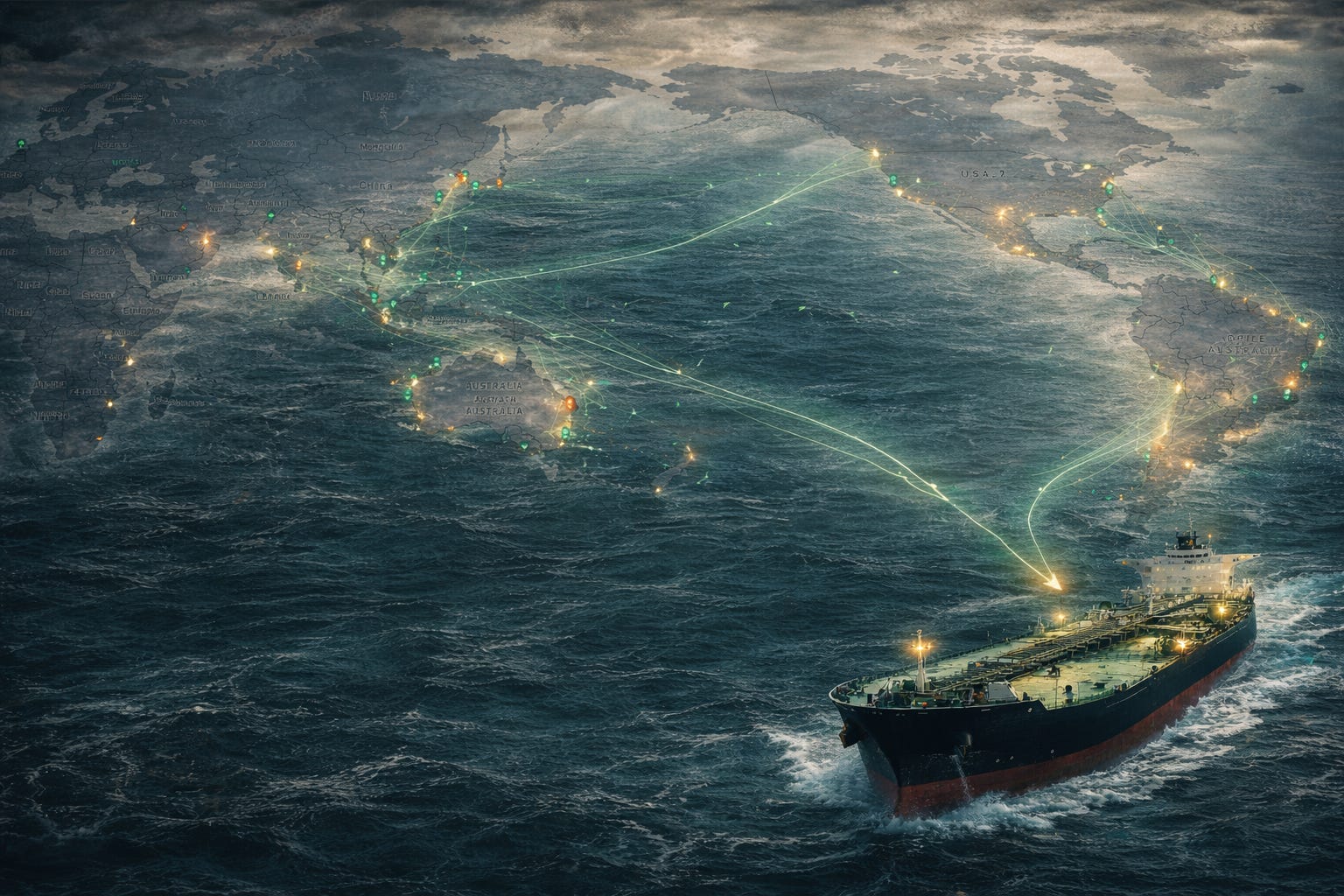
Australia’s future now hangs on a complex international chess game involving ships carrying liquid fuel from distant refineries across the oceans to our shores.
It is sobering to track this traffic in real time on a Kpler dashboard, where loaded vessels appear as green arrows inching towards their destination. Touch an arrow and the name of the ship appears, along with its cargo, the port it left and the one it is bound for. That thin green line pointing towards Australia is all that stands between continuity and crisis in this island nation. If it breaks, or even slows, the effects here will be swift and severe.
Kpler is a global trade intelligence company that sits at the nerve centre of the physical economy, stitching together billions of data points to show how energy and commodities are actually moving around the world. It has generously given this column access to its data.
Isolate the trade in diesel, petrol and jet fuel to Australia and it shows 36 ships on their way at the time of writing. Twenty-eight are coming from the Asian refineries that usually supply 90 per cent of our fuel. More than two of these ships must off-load at a port here every single day to feed our voracious appetite for liquid fuel, as more than 40 per cent of all the energy consumed in Australia is burned in the engines that drive transport, mining and agriculture.
The notable recent shift in the fuel trade is the emergence of long-haul supply. Four ships have crossed the Panama Canal after loading on the US Gulf coast. Two more have sailed from a refinery in Washington state and another was loading there on Thursday. Historically, fuel imports from the US have been rare, so a distant and more expensive supply line has been tapped to keep Australia moving.
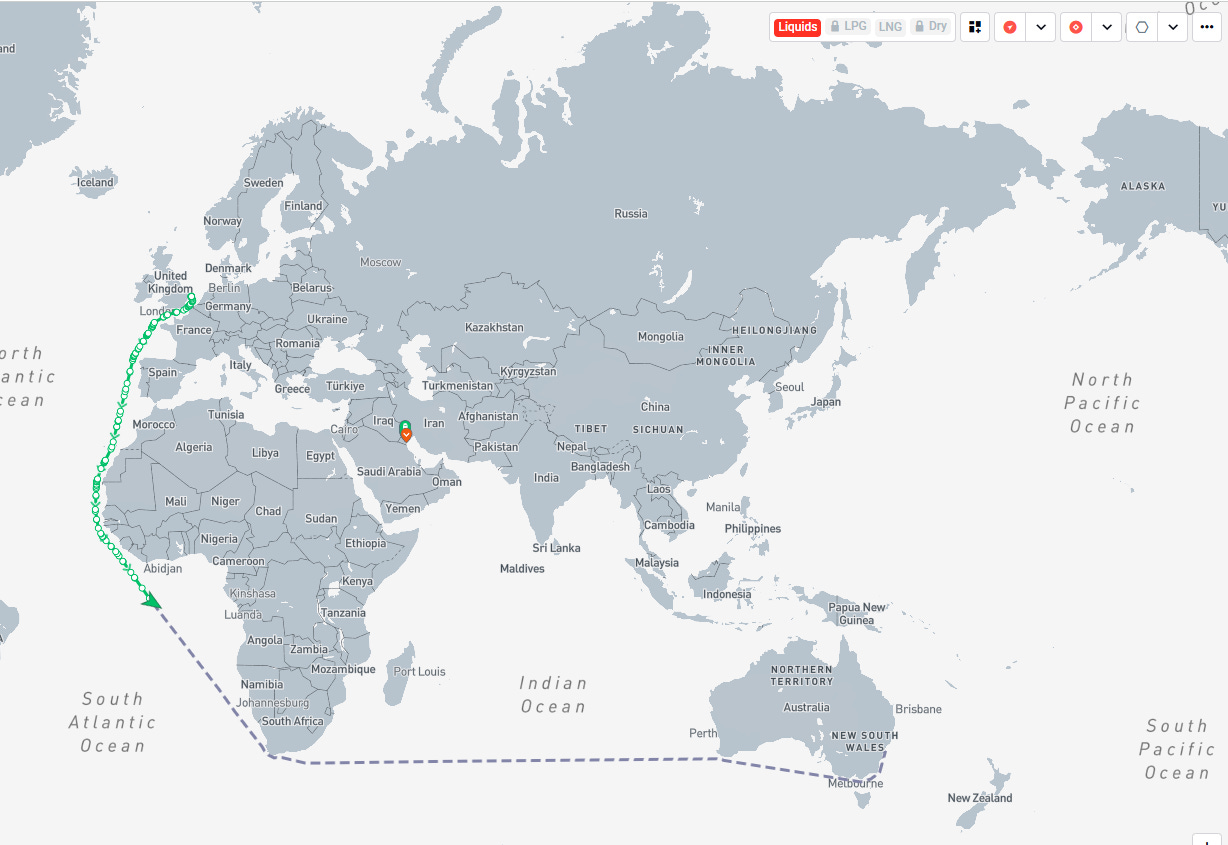
But one cargo now slowly tracking down the west coast of Africa stands out, and its journey here tells the story of a nation scrounging around the world to fill supply gaps at any price.
The STI Solace set sail from Southwold Anchorage, off the Suffolk coast, on March 19 and is due to dock in Sydney on April 29. It is a mid-sized tanker carrying nearly 654,000 barrels of fuel, or about 104 million litres. It sounds like a lot but Australia uses about 173 million litres of refined fuel every day. So the STI Solace has enough fuel in its tanks to keep the country running for little more than half a day.
On paper, this cargo looks like a shipment from the UK. But the fuel did not originate in Britain. It was transferred there.
Another tanker, the Oslo Star, loaded this cargo from a refinery in Kuwait in mid-February and sailed out of the Gulf before the shooting started. It then tracked west into the Red Sea and up through the Suez Canal, emerging into European waters in early March. As it crossed the Mediterranean and entered the Atlantic, its destination shifted repeatedly, first towards North Africa, then Rotterdam and finally to an anchorage off the Suffolk coast.
When it reached Southwold on the morning of March 19, the cargo was transferred ship-to-ship on to the STI Solace, which set sail that evening and is now carrying it halfway around the world to Australia.
Kpler’s data goes back to 2014, and this is the first time the company has recorded such a trade.
The complex logistical dance was choreographed by the Scorpio Group, a Monaco-based company that operates large fleets of tankers moving fuel between continents. Firms such as this do not produce energy. They move it, trade it and, since the war in the Gulf kicked off, redirect it in response to price and scarcity.
Forgive the blizzard of detail, but it reveals something important. This was not a shipment planned for Australia. It was a cargo looking for a buyer and in the end Australia paid the highest price. So this is not a straight supply chain, it is an expensive relay where each baton change adds costs and complexity.
Australia is now engaged in a bewildering and increasingly desperate global scramble for fuel in a deeply fractured market. Our security sits largely in the hands of major producers and international traders who are constantly reshuffling cargoes to meet demand. When supply tightens, the system stretches. Cargoes are rerouted. Ships change hands at sea. Fuel travels farther, costs more and takes longer to arrive.
The world entered this crisis with good supply and a significant volume of oil, including a black fleet of sanctioned Russian cargoes, sitting on the water in tankers. That floating stock is now being rapidly drawn into the market at higher prices. No one is knocking back Russian fuel any more. But this is a limited buffer. As those cargoes are absorbed, the global chessboard will start to lose pieces and supply will tighten further.
In the gap between supply and demand lies the risk. The longer the Strait of Hormuz remains constrained and under the control of Iran, the more precarious this market becomes. It should be noted that Iran is still shipping oil and making a hefty profit on it.
In the supply chain chess game the Albanese government is a bystander.
That was writ large in the Prime Minister’s address to the nation and his speech at the National Press Club. When asked about the fuel crisis, Anthony Albanese talked about tempering demand by travelling less or lowering costs by cutting the heavy vehicle duty, the fuel excise and the GST.
These are price and demand Band-Aids on a haemorrhage of supply.
The government’s only supply-side moves have been to change rules to allow the limited amount of fuel we refine to stay onshore and to let the Export Finance Corporation underwrite additional fuel shipments. This is to provide comfort to the big energy companies that source the fuel.
The cargo on the STI Solace would have come at a premium. If the price drops in the month it takes to get here, the taxpayer will wear the cost.
When asked about his long-term plans to secure supply, the Prime Minister said everything was on the table but then ran through the usual bureaucrat’s list of reasons that most of it would be too hard, take too long or be too expensive.
It should be self-evident to even a casual observer that our future depends on becoming self-sufficient in liquid fuels as rapidly as we can. It will not be quick, cheap or easy, but contemplate the alternative. If the fuel stops, Australia stops.
That means using conventional and unconventional methods to secure the fuel we need to run the nation. Western Australia and Queensland have oil. NSW has gas and, as Robert Gottliebsen has argued in these pages, Victoria’s vast brown coal reserves should be tapped. Technologies now exist to convert coal into diesel and aviation fuel, turning a stranded resource into a strategic asset.
Energy security is national security and our security is now out of our hands. This was a wilful, catastrophic failure of the political class more than 20 years in the making. This crisis should be the catalyst to fix it but the early signs are not good.
Anyone who says electric cars are the answer is not serious. They have a role, but truck traffic between Sydney and Melbourne on the Hume Highway alone runs at 1900 B-double equivalent trips a day. That is 700,000 trips a year. The technology to rapidly replace all that traffic at the same cost and efficiency as diesel does not exist.
Just before Albanese addressed the press club, Donald Trump spoke to his people. The American President made the point that the US could walk away from the war in Iran without reopening the Strait of Hormuz because his country did not rely on it for fuel security.
He is right. After decades of declining oil production, something extraordinary happened to US energy supplies from 2010 on. The shale oil revolution turned the US into the world’s biggest producer of oil and natural gas.
Trump can walk away from the war with Iran and his country will absorb the shock. Prices may rise. Consumers will feel it. But the system holds. The US has choices. Europe and Australia do not.
That is what makes this moment so stark.
The world is organised around energy. As the world’s best energy analysts at Doomberg argue, power, prosperity and security flow from those who produce it. For decades, globalisation obscured that reality. Oil moved freely, trade routes were protected and supply chains, though complex, were dependable. The Gulf war has exposed how fragile the old system was. That world is breaking and will not return to business as usual.
Supply is no longer guaranteed. It is contested, disrupted and increasingly weaponised as the global energy market fragments into competing spheres of influence.
In the emerging world order, geography and resources matter again.
The US, Russia and China are well placed in the new order. They have energy within their borders or within their reach. Europe does not. Australia has it but has chosen not to use it. Both have come to rely on long supply chains in a world where distance is now a vulnerability. Both have demonised the fuels on which their societies run. This virtue signalling is a vanity we can no longer afford to indulge.
Doomberg’s central insight is that energy systems do not evolve gradually. They appear stable, then shift suddenly when a shock hits. When that happens, the system does not return to what it was. It reorganises around new realities.
For exposed, import-dependent nations such as Australia, the implications are profound. Energy is not just another commodity. It is the foundation of economic life and national security.
We can ignore that truth or we can act on it. Because if we do nothing and that thin green line breaks, so do we.
This article was first published in The Australian
Thanks for an excellent post, Chris. Europe, the UK, and Australia have done it to themselves. I don’t believe they can continue virtue signaling forever. Only they know how much pain they are willing to endure for the CO2 Climate Cult.
My question is, do our Federal Leaders (on both sides of Parliament) have the requisite courage and conviction to finally address the strategic energy supply gaps which have been so graphically highlighted by this latest crisis?