


“We will make electricity so cheap that only the rich will burn candles.” — Thomas A. Edison
The Australian has reported that the number one concern of 526 companies is energy prices. It ranked ‘three times more prevalent than worries over changes to tariffs and international trade disruptions’.
Manufacturers Alcoa, Qenos, Oceania Glass and Oji Fibre Solutions came to the same conclusion when they shut down operations in Australia.
Since 2018, more than 200 companies — including Tesla, Oracle and Chevron — have relocated from California to Texas to take advantage of cheap and reliable power. California’s obsession with renewable energy mandates, grid congestion costs and its regulatory environment means electricity there costs five times more than in the Lone Star State. In short, California charges US$0.30/kWh versus Texas at US$0.06/kWh. Is it any wonder that California’s manufacturing sector has halved as a share of gross state product since the late 2000s?
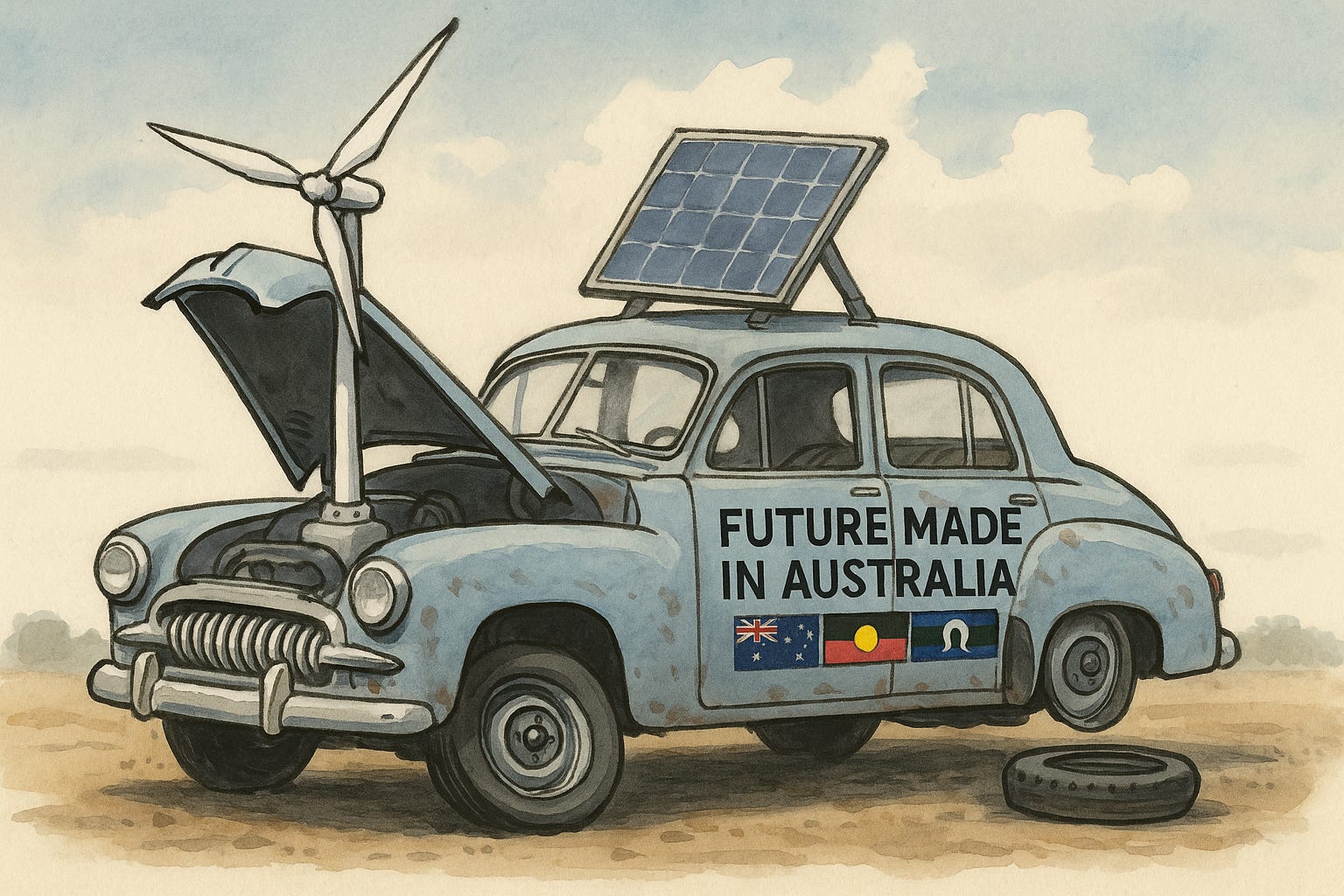
Which begs the question: how can the signature Albanese government policy of a Future Made in Australia (FMIA) stand a chance if the backbone of manufacturing — cheap energy — is not available?
Putting aside the fact FMIA spending is a mere one-fifth of what’s spent on federal public sector superannuation every year, the program is a poster child for the extremely low-resolution thinking that pervades the very government departments that devise it — no commercial nous.
Take these three examples from the five FMIA ‘vectors’ in the program.
1. Green steel
Japan’s Nippon Steel and South Korea’s Pohang Iron & Steel Company (POSCO) are currently in the due diligence phase to invest in the 1.2 million tonne-a-year Whyalla Steelworks, which is the beneficiary of a $2.4bn government bailout. For the avoidance of doubt, the Japanese and Korean governments are pretending to show interest in green steel to negotiate long-term predictability on coal and gas supplies as the main aim. Need proof?
Before Whyalla was ever a discussion, Nippon Steel and POSCO claimed green steel was too expensive. Both companies are only prepared to run small-scale pilot programs over the next 20 years at less than one per cent of their respective global outputs. It is an exercise in external optics — nothing more.
2. Clean energy manufacturing
FMIA has ambitions to build 20 per cent of our solar panels domestically, up from less than 1 per cent today. This, despite 90 per cent of the world’s panels being made in China, where slave labour and coal-fired power input costs haven’t helped industry giants avoid US$60bn in aggregate losses or save 30 per cent of their workforce from retrenchment in the last fiscal year — because there is 300GW of oversupply, more than twice global demand. What could possibly go wrong?
3. Critical minerals
FMIA loves to spruik our credentials as a critical minerals superpower. All Australian mining jurisdictions have fallen out of the top 10 in the Fraser Institute Global Mining Attractiveness Survey released in July 2025. NSW and Victoria not only fell into the bottom quartile but now rank below the DRC, Zimbabwe and the Ivory Coast. The feedback is brutal, which is why the majority of ASX-listed miners remain penny stocks. The market does not see a future.
Australia today
In 1990, manufacturing made up 14 per cent of Australian GDP. Today it is barely above 5 per cent. Employment in the industry has fallen from 1.17 million to 885,000.
Our mining sector employs 326,000 — four times 1990 levels. Yet our policies increasingly shame industries where we have overwhelming competitive advantages: coal, iron ore and LNG. Higher royalties, onerous regulation and an uncompetitive renewables ideology continue to erode international investor confidence. Exhibit A is Chevron pulling up stumps after seven decades.
Expensive energy is driving our private sector out of business, with 15,000 closures earmarked for 2025 — 36 per cent higher than the 39 per cent spike of 2024.
It is worth paying attention to three manufacturing nations ahead of Australia in the renewables transition. They paint a stark message for what lies ahead if we do not wake up and reverse course.
United Kingdom
The UK gets around 33 per cent of its energy from wind and solar. It has some of the most expensive electricity prices in the world, pushing north of 40c/kWh.
British firms are paying up to 100 per cent more for industrial-use electricity than competitors. Manufacturing as a share of GDP has fallen from 16 per cent in the 1990s to 9 per cent today.
Energy-intensive industries are being hit hardest, with output at a 35-year low. British steel production has collapsed from 12 million tonnes in 2013 to 4 million today. Chemicals output has declined 40 per cent since 2021.
Thirty-eight per cent of manufacturers have financial health scores indicating a one-in-four chance of insolvency or restructuring within three years. High energy costs are the primary driver.
The scale of job losses in manufacturing has been nothing short of horrific. An estimated 147,000 workers have lost their jobs or are at risk of redundancy in 2024.
Notable factory closures and/or widespread retrenchments include British Steel, Tata Steel, Vauxhall, Jaguar Land Rover, Dow Chemical, Saudi Aramco-owned SABIC, INEOS, Dyson, Kellogg’s and McCain.
Germany
Germany is operating at 40 per cent renewables, and a similar pattern of industrial self-sabotage is afoot.
Wholesale prices have frequently exceeded €500/MWh during droughts in renewable energy production (known as Dunkelflaute) following the closure of nuclear power plants and the phase-out of coal-fired power.
In 2024, a record 196,100 German companies permanently ceased operations, up 16 per cent on 2023. Energy-intensive businesses were decimated, with 1050 companies closing down — a 26 per cent year-on-year jump. The manufacturing sector has shed 270,000 jobs since 2019.
The world’s largest chemical firm, BASF, has closed 11 factories at home as it faced an 84 per cent hike in energy costs — equivalent to an additional €3.2bn in 2022 alone. Volkswagen has announced it will close at least three German plants, the first time in the company’s 87-year history. It will trim production by 734,000 units and its workforce by 35,000 by 2030 as a result.
A 2024 German Chamber of Commerce and Industry (DIHK) survey revealed 37 per cent of German companies are considering reducing domestic production or relocating overseas, up from 22 per cent in 2022.
In response, the German government has announced relief measures of €42bn between 2026 and 2029 to subsidise energy costs.
Spain
Spain derives around 40 per cent of its electricity from renewables.
In the last 12 months, electricity prices exceeded €100/MWh for five straight months — double the average of the last quarter-century. The start of the Ukraine conflict saw prices surge to unprecedented levels of more than €540/MWh, with peak hours reaching €700/MWh.
In April 2025, a nationwide blackout affected 60 million Spaniards for ten hours. The cause was naturally papered over by the authorities as having nothing to do with renewable energy shortcomings, instead blaming poor planning by the grid operator for failing to ensure adequate backup to stabilise the system.
Spain’s industrial sector has been in long-term decline. Manufacturing jobs fell from 17.8 per cent of total employment in 2000 to 9.9 per cent in 2024. The manufacturing sector shed 107,000 jobs in 2024 alone.
Notable factory closures and/or layoffs caused by energy price hikes include Michelin, Bosch, Bridgestone, SABIC, ArcelorMittal, Saint-Gobain and Alcoa. ArcelorMittal stated: ‘The cost of electricity is unsustainable for energy-intensive industries.’
In summary
Without cheap energy, FMIA is a pipe dream. Europe is already showing us how renewable energy is killing the very corporates supposed to benefit from the transition. Thankfully, Australian businesses are finally starting to say the quiet part out loud. The question is whether it is too late.

Now they are getting alarmed, but where were they during the last couple of decades when all this was brewing?They started to get a bit worried a few years ago and I drafted this for a piece that did not get published.
THE JUDAS SHEEP ARE GETTING SHEEPISH
Most of the business leaders in recent times have disgracefully performed like “judas sheep,” leading the flock to the slaughterhouse.
Too many leaders of industry groups and board members of corporations betrayed the interests of their members and shareholders, and the national interest as well.
They embraced wokeness and pushed or failed to resist a laundry list of destructive, divisive and productivity-sapping progressive causes. You name it - net zero, The Racist Voice, DEI, same-sex marriage, lockdowns, mandatory jabs, union-driven IR reforms.
Jennifer Westacott showed the way during her tenure at the Business Council of Australia. She has moved on to pasture in higher education but her spirit lives on. Last year the BCA announced that it was looking forward to working with the Net Zero Economy Authority “ensuring the transition to net zero creates improved business and employment outcomes across communities.”
Some of the captains of industry are having a “road to Damascus” experience, call it a “Road to Net Zero” experience. Well, not quite, Paul on the road to Damascus changed from persecuting Christians to leading them. Our current travellers still want to go to Damascus, but not so fast.
Some of the usual suspects have been out and about lately, pleading for a less punishing timetable for the green transition, more realistic or “doable” targets for 2030. Oh but we still want to get to net zero by 2050 of course.
This may sound prudent and reasonable but it denies the brutal reality that the transition to wind and solar power won’t happen because it can’t because there are wind droughts and there is no grid-scale storage.
AND THE TREASON OF THE PUBLIC INTELLECTUALS Strangely not published by The Australian.
Almost exactly 100 years ago in France, Julian Benda wrote The Treason of the Intellectuals to challenge the chattering classes to cease and desist from stoking the violent political passions that were dividing the Republic.
At present public intellectuals in the quality press have the opportunity to be role models in critical thinking about difficult and divisive issues à la Benda.
Responsible public intellectuals will engage with the signature issues of the time to establish one or more areas of competence where they have more or less well-informed opinions. They can provide invaluable guidance to advance informed public debate on those matters because they have access to the best brains in the country to help them to explain and clarify scientific and technical matters.
If they do their homework in their areas of competence they can be taken seriously, with the usual reservations about experts. On other topics they have no more credibility than their readers because we can only recycle what we regard as reliable opinions offered by other people.
Paul Kelly is a leading public intellectual on the basis the circulation of The Australian, his books, and the years that he has spent reading, observing and writing about Australian politics. That is his area of competence, as he demonstrated in his appraisal of the prospects for nuclear power.
In The Australian 10/11/2021 he described the idea of conservatives winning an election with a promise of nuclear power as “a grand fantasy” because it will take years to achieve bipartisan support at the Federal level and state levels. “It would never be established amid an energy policy war between the coalition and labour.”
Contrast that considered opinion with his position on climate change and net zero. He apparently accepts that the science is settled in favour of warming alarmism despite the empirical evidence that the warming in modern times has been beneficial and we are still short of the temperature during the Roman warm period which was even more favourable for life on earth.
Similarly, the post industrial increase in the level of CO2 has been literally life-saving because the level of CO2 during the Little Ice Age was barely enough to keep the plants alive. Still, Kelly exhorts us to make all efforts to achieve net zero even if we can’t do it by 2050. In The Australian, 6/2/2021 he applauded Morrison’s commitment to net zero and the Paris accord, against “blind conservative resistance.”
Likewise, Greg Sheridan has an area of competence in foreign affairs and defence, while he deplores the misguided folk who refuse to dance to the tune of the climate alarmists and the net zero enthusiasts.
In my opinion, when public intellectuals aggressively assert their views on important and controversial matters that are outside their areas of competency, they should warn the readers that they have wandered out of their lane. If they have not checked the facts and consulted well-qualified experts on both sides of the case they may unwittingly mislead their readers.
Climate and energy became signature issues after warming alarmism emerge in the US in the 1980s and there has been plenty of time for senior journalists to learn enough to form realistic views on climate and energy policies.
Some have done this, Terry McCrann, Andrew Bolt, Graham Lloyd, Piers Ackerman and Chris Mitchell for example. Some politicians have done the same, notably Malcolm Roberts, Craig Kelly, Matt Canavan, Alex Antic, Gerard Rennick and Ralph Babet. In the street there are many others, like the Five Dock Climate Realists in Sydney, who have done the hard yards to achieve robust positions without holding formal qualifications in climate science.
Too many commentators and editors have metaphorically shouted “Fire” in the crowded theatre of the climate and energy debate and enabled the unsettled science of climate alarmism to capture the hearts and minds of the people and the politicians. That process was accelerated by publicly funded activists in the ABC, the schools and the universities, especially the university-funded site The Conversation where alternative views are excluded by editorial fiat.
That unsettled science drove the net zero crusade around the world that has wasted trillions of dollars to get more expensive and less reliable power with massive collateral damage to forests and farmlands.
Utility prices for gas, water, electricity are also inflated by a corrupt regulatory system which allows utilities to keep charging users again and again for infrastructure structure they paid for long ago, such as NSW power stations or Warragamba Dam.
"Replacement cost" valuation and charging methods mean users pay and pay over again for a rate of return on assets long since paid for. It's as if you keep getting charged rent for the house you paid off years ago.
The Productivity Commission is an abject failure on utility charges.
Talk about a bullet to the head of value adding industry in a rather dumb country.