


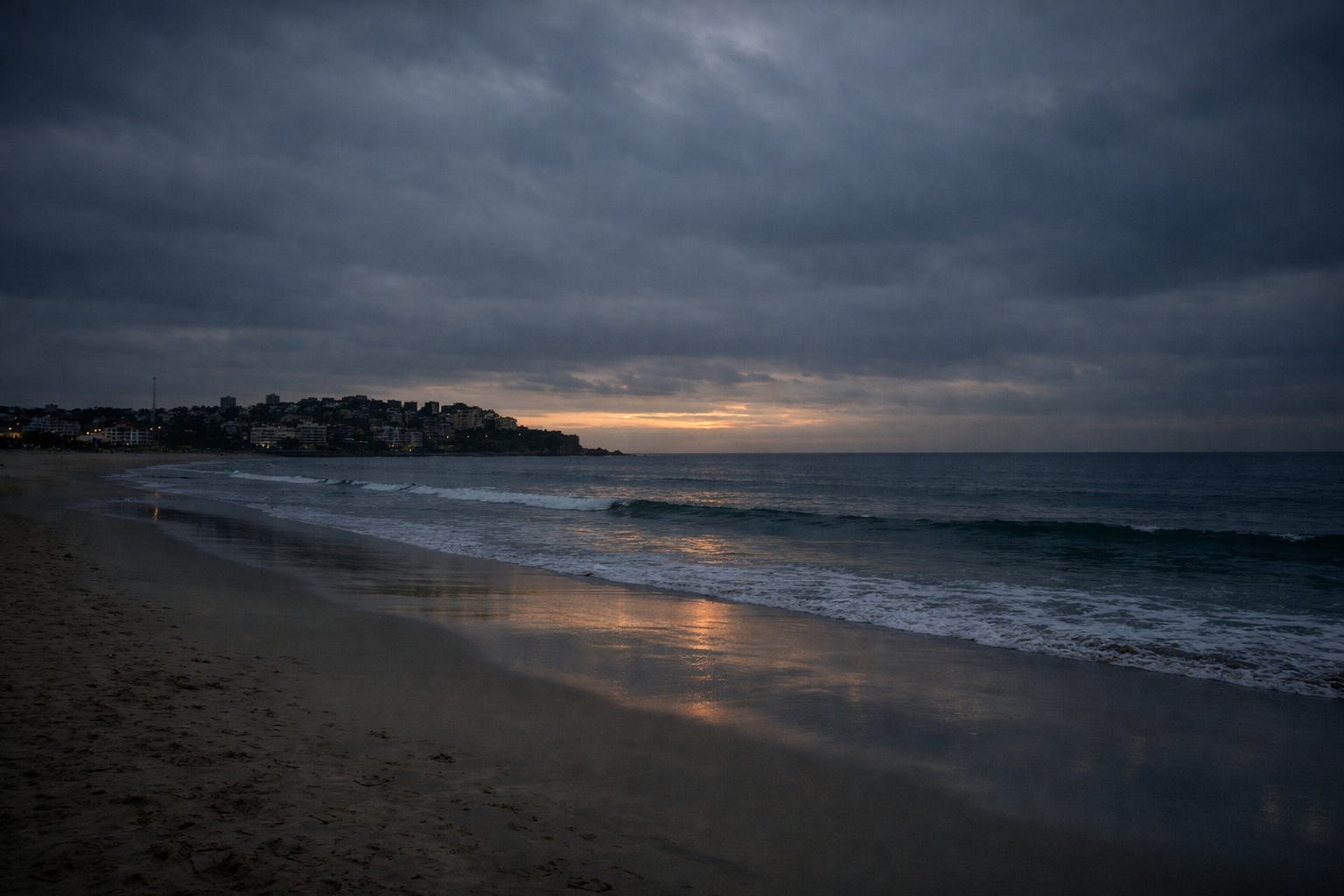
The beach is soaked in blood no tide will wash away, and among the dead lies a child with that most Australian of names: Matilda.
Her murder, along with 14 other souls, stains the Bondi sand and our nation. The horror lies in knowing this was no senseless slaughter of innocents. This was a cold, calculated assault on a people whose only crime was their religion. Terrorists’ rifles were aimed at snuffing out lives, leaving permanent physical and spiritual wounds and cleaving our community.
As the Children of Israel celebrated their festival of light, darkness came in the shape of executioners bearing a flag that soils the name of the God they feign to sanctify. Words fail before the brute desire to kill. The crack of gunfire drowns out all reason, and we are left bewildered at a hate so raw it could stare down a gunsight at a child and pull the trigger.
This visceral hatred has a diabolical heritage, rooted in the desecration of a faith. What we witnessed was a religion corrupted into a nihilistic cult, where death is sanctified as an oblation to a false god. To insist this has nothing to do with Islam is cowardice. It is to evade the truth that a worldwide battle is raging for the soul of that faith, and it will not be won by denial. Many of its victims are Muslims. We should stand with those within Islam who reject this rank corruption of their beliefs and are willing to name it, confront it and defeat it.
Because only one name befits this act: evil. That evil now lurks in our suburbs and infects the minds and hearts of many more than just two assassins. This is a dangerous age, and what we do from here will define us. Fortune will not favour the weak.
In the wake of the slaughter, images play relentlessly on every screen, as clip by clip of a dozen minutes of chaos are drawn from hundreds of cameras to fill the jigsaw of the killers’ murderous arc.
And we are left to wonder what this picture means. What is this Australia?
But in the darkness there were flashes of light. Ahmed al-Ahmed lived up to his poetic name: the praised one, son of the praised. His is the courage all hope they will show in a crisis, as he wrestled the gun from the assailant. It was an essential reminder that Islam is not owned by those who defile its name with their bile. It now falls to Australian Muslim citizens, with our support, to deal with the extremism in their community.
Then there was the defiance of Reuven Morrison, who picked up a brick to throw at the killer before being gunned down. In an echo of the Warsaw Ghetto Uprising, his dignity shone in how he chose to die, the act of a man who would rather be killed than be cowed.
As Viktor Frankl observed in the death camps, the last of the human freedoms is the ability to choose one’s response to abject evil.
Then Boris and Sofia Gurman, who tackled a gunman before the shooting started and died side-by-side on the footpath, ending 35 years of marriage in each other’s arms. May they stay that way for eternity.
Then all the ones we did not see. The silent moments of heroism from citizens who saw their civic duty as selflessness. The police and the surf lifesavers who chose to risk their lives for others. This is not a job; it is a vocation where routine sacrifice is too little honoured.
But beyond the heroes, hard questions remain for our country. Are we to be a nation of tribes? A place so shattered by the insidious politics of identity that it has no idea what it is? What are the values that we share?
There is too much diversity and too little unity hidden behind bunkum words like multiculturalism. The balance is tipped too far by those who denigrate our history, ignoring that the democratic foundation stones on which we stand were laid by those they deplore. The rights we take for granted are inherited, and Bondi’s heroes remind us that citizenship is also a responsibility.
A nation cannot thrive without a common set of values. What are ours? What is worth honouring, what is worth sustaining? What should we never countenance? What would we be prepared to die for?
Too often we hear cant phrases about shared values from those who cannot define them. Values have a spiritual dimension. Values were demonstrated in the actions of Ahmed al-Ahmed, and when the Gurmans gave up their lives in an act of grace to protect people they did not know.
Their courage personified that value best articulated in the testament we inherit from Jewish scripture: you shall not kill. The moment murder is justified, everything collapses.
There is only one religious reference in our Constitution, where the authors say the colonies “ … humbly relying on the blessing of Almighty God have agreed to unite in one indissoluble Federal Commonwealth”. If we plan to remain indissoluble, then Australia’s values must be anchored in more than mechanical refrains about institutions or trite tilts to “fairness”.
In his wartime reflections, Liberal party founder and former prime minister Robert Menzies said: “It is only that democracy which sees the superb spiritual value of the individual … which can really win a crusade against tyranny and force, and lead the way into a better world.”
Our values did not emerge from nowhere. In this country, as in every Western liberal democracy, they rest on a moral inheritance that is unmistakably Judaeo-Christian, articulated most clearly in the Decalogue. Do not kill. Do not steal. Do not lie. Do not bear false witness. These are not sectarian curiosities or private articles of faith. They are the moral guardrails that make freedom and civilisation possible. You do not have to believe in God to live by them, but you cannot abandon them without consequence.
A society that refuses to name its moral foundations will not long be able to defend them, and a nation that cannot say what it stands for will discover, too late, what others are prepared to destroy.
We need to write a decalogue for democracy in Australia if it is to endure. As Menzies said, the problem of democracy began when democracy was achieved.
“If government were by a despot, amiable or vicious, we, as the governed, might well shrug our shoulders and resign ourselves to fate,” he said. “But when government of ourselves is by ourselves, we must bestir ourselves. If, then, there is tyranny, it is our own.”
Soon it will be Christmas. It is a time to celebrate the birth of a child, which is understandable in all faiths, and none, as an enduring symbol of hope.
But this Christmas will be different. Here it will carry the unsettling tone of T.S. Eliot’s Journey of the Magi when he asks: “Were we led all that way for Birth or Death?”
“There was a Birth, certainly,
We had evidence and no doubt. I had seen birth and death,
But had thought they were different; this Birth was
Hard and bitter agony for us, like Death, our death.
We returned to our places, these Kingdoms,
But no longer at ease here, in the old dispensation.”
We need a new democratic dispensation that finds a unity of purpose and a genuine sense of a shared national mission. It is a hard journey that begins with sacrifice. It will be found in the spirit of Bondi: valuing your community above all else.
As Menzies said, “If man is to be adjusted to man, if we are to live together in mutual amity and justice, if we are to be dignified without being proud or overbearing, we must be givers rather than receivers; we must be quick to discharge our duties and modest about our rights.”
Amen. Light a candle for Matilda and each of the fallen this Christmas to drive out the darkness. And let us pray that, somewhere, they are waltzing.
This article was first published in The Australian.
A great article. It makes me somewhat despondent to see supposedly intelligent people believe the propaganda of Hamas, The truly genocidal fanatics of Gaza.
‘It now falls to Australian Muslim citizens, with our support, to deal with the extremism in their community.’
And, equally pertinent in my view, for the radical Left element in the Australian community to stop rationalising and pandering to this same group.
Merry Christmas