


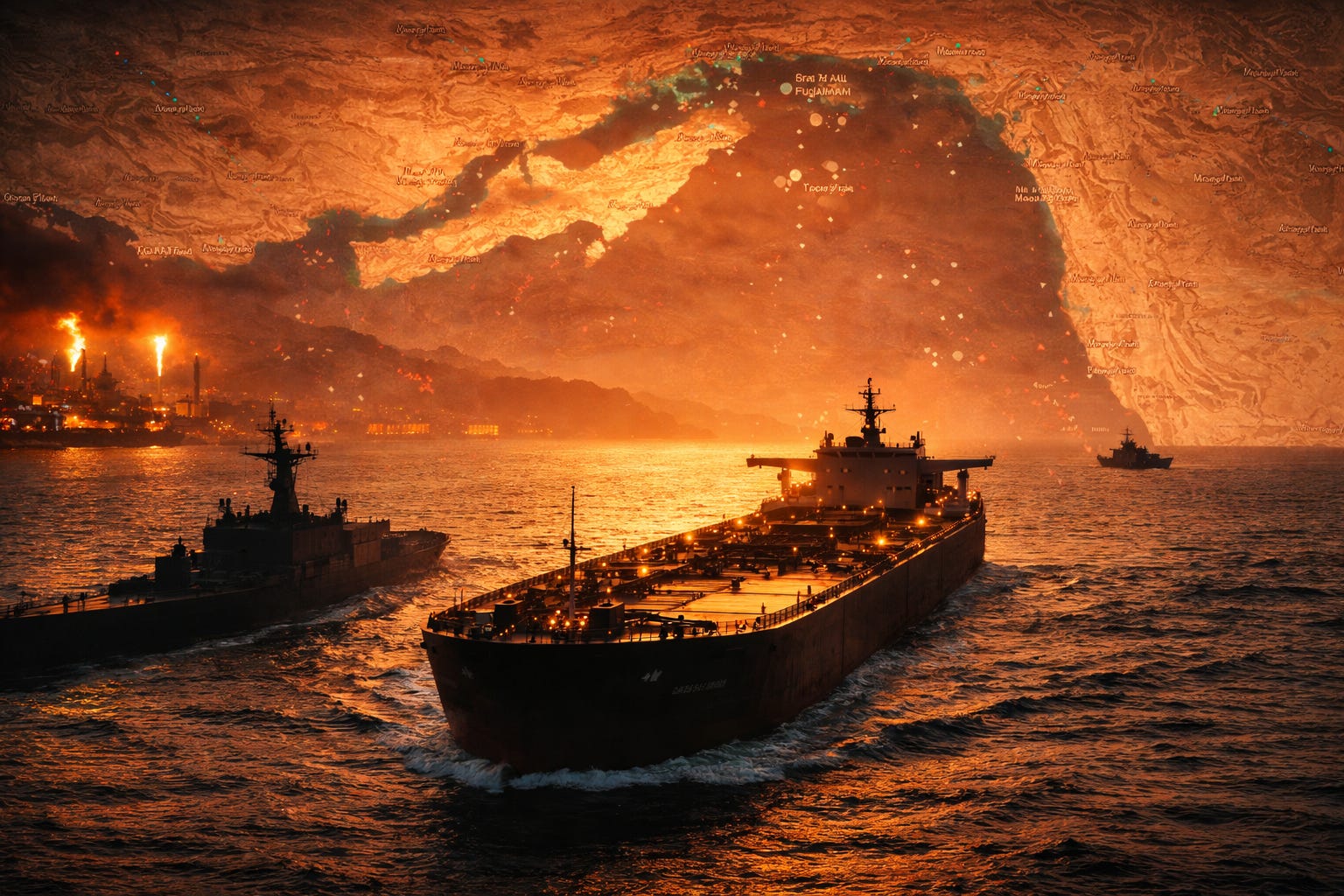
The current Middle Eastern war underscores how the world really works and what fuels it runs on.
First, as Chairman Mao Zedong put it, “Political power grows out of the barrel of a gun.”
International law is a mirage that middle powers cite, evil powers exploit and superpowers honour in the breach. If you have the guns and are willing to shoot, you make the law. There is no international police force and no penalty for starting wars beyond the unimaginable consequences that flow from them and the high risk that you will shoot yourself in the foot.
Second, the world runs on hydrocarbons. This is also real power. The troika that delivers more than 80 per cent of the world’s primary energy is still coal, oil and gas. Energy security is essential and green energy an aspiration. With the war choking off one-fifth of the world’s supplies of oil and liquefied natural gas, the price of both has spiked. So has the price of coal because it can be substituted for gas in power production. If this persists for any length of time, the world will rediscover a brutal truth: energy shortages spread quickly from stalled tankers to inflation, industry and politics.
Europe has seen its natural gas prices surge by 70 per cent because it has decided it is best to import every molecule of the fuel that is essential to keep the lights on in its weather-dependent electricity system. To lose one gas supplier may be regarded as a misfortune; to lose two looks like carelessness.
First, Europe bet on the goodwill of a gangster in sourcing gas from Russia, then on enduring stability in the Middle East as it switched sources to Qatar.
Energy security is national security, and Europe is an energy vassal. That Australia is determined to mimic it is an act of supernatural stupidity.
In passing, let’s also add that Iran is specifically targeting energy infrastructure right across the Middle East as it lashes out in self-defence. Here it is following a playbook used by Russia in its war on Ukraine. This underlines the fact that despots understand what our government does not: energy is the economy. Cripple a nation’s power supply and everything else collapses. Note that no one is blowing up wind farms.
Finally, no one knows where this conflict will lead and there is every chance that 25 years from now we still will be kicking through the rubble, marvelling at what new horror has slithered out.
When God banished Satan from heaven in Paradise Lost, the Prince of Darkness simply set up shop in hell, determined for the rest of eternity: “To do aught good never will be our task, but ever to do ill our sole delight.” Humanity was collateral damage. Satan no doubt has welcomed Iran’s recently arrived supreme leader to Hades as a handy utility player on Team Damnation.
Working on a documentary marking the 30th anniversary of the election of the Howard government served as a timely reminder that wars bleed into each other.
The 2003 US-led coalition that deposed Iraqi dictator Saddam Hussein removed Iran’s main rival in the Persian Gulf and reshaped the region’s balance of power. Tehran exploited the vacuum by backing Shia militias in Iraq and expanding a network of proxy forces across the region, from Hezbollah in Lebanon to Hamas in Gaza and the Houthis in Yemen. This entire edifice was aimed at erasing Israel from the river to the sea.
No less an authority than Donald Trump agrees. At the February 2016 Republican debate in South Carolina, he called the Iraq war “a disgrace and an embarrassment”.
“I said it loud and clear,” Trump said. “ ‘You’ll destabilise the Middle East.’ That’s exactly what happened.”
There is no doubt John Howard sincerely believed the US and British intelligence assessment that Iraq possessed weapons of mass destruction when he committed Australian forces to the fight. In an interview with Sky News, former prime minister Malcolm Turnbull said the war was a massive mistake but defended Howard’s reasoning.
“John always had this view, rightly or wrongly, that the British had insights into the Middle East because of historical connections that were separate and, in some respects, better than those of the United States,” Turnbull said. “So, he was comforted by the assurances he was getting from London more than he was comforted by the assurances he was getting from Washington.”
The Iraq war was a case of imperial overreach that did great damage to the US domestically and internationally, and the consequences echo to this day.
But it should be remembered that president George W. Bush followed a long and public road to it. Congress authorised the invasion, the UN gave Iraq a final warning to comply with weapons inspections or face “serious consequences” and secretary of state Colin Powell made the case before the UN Security Council.
Howard believes his decision to support the US was right.
“I think both as a foreign policy decision, but also as an expression of our closeness to the United States,” he told Sky News. “I mean, we expected them in a pinch to help us, and although they didn’t physically need us, they wanted … a coalition of the willing.”
That coalition grew to 49 countries that supported the operation, though only a handful contributed combat troops. It is timely to remember that one of those countries was Denmark, which deployed a combat battalion to Basra and lost seven soldiers during four years of fighting.
Former foreign minister Alexander Downer believes “it was a great thing to get rid of Saddam Hussein”.
“I think that the counterfactual is the world would have been more unstable and worse with Saddam Hussein remaining in power, even though I can see the Americans handled the post-invasion period very, very badly,” Downer said.
That they did, and those errors linger to this day. Now there is another war to fix the problems left by the last and we are promised this one will go better, though no one in the Trump administration can say with any clarity what better looks like. Time will be the only judge.
We cannot foresee the future but we know this much: we live in a more uncertain world than the one we thought was enduring after World War II. In many ways it has returned to type: the powerful do as they will and the weak suffer as they must.
This world demands prudence and that is an enduring value that this era could learn from the Howard government.
It began with budget discipline. On day one of its tenure, treasurer Peter Costello discovered he had inherited an $11bn deficit, despite the Keating government insisting the books were in surplus. That shortfall was about 2 per cent of GDP. The government took out the razor, made tough choices and two budgets later delivered a surplus. With persistent surpluses, net debt was reduced from 18 per cent of GDP in 1996 to zero a decade later. For a few brief years the commonwealth was worth more than it owed.
Now the budget has a decade of deficits ahead of it and net debt stands at about $620bn, or roughly 21 per cent of GDP. We are in no fit state to deal with a crisis. Budget repair is a national security priority.
And the Howard government understood that defending a nation began with defending its borders. It took a hard line on illegal boat arrivals, insisting that control of Australia’s borders was not a matter of sentiment but sovereignty.
Those decisions were bitterly contested domestically at the time and deplored in the polite parlours of Europe and denounced in the UN. Now most nations understand that deciding who comes to a country and the circumstances in which they come is a bedrock function of the state.
Nations that cannot control their finances can’t afford to defend themselves. Nations that cannot defend their borders risk societal collapse. And energy-poor nations are just poor.
Watch John Howard: A Life in Politics on Wednesday 11 March at 7.30pm AEDT on Sky News. Stream at Skynews.com.au
Great article Chris. I live in hope that the people will begin to realise that energy security, food security, economic security and national security are all interconnected. Alas Canberra and its allies in the mainstream media still seem to be chasing a progressive utopia. Not sure what it will take to shock them out of it - a serious spike oil prices maybe?
Chris, I love your doses of reality amidst all the magic thinking. Still, a corrective note on the effects of the 2003 overthrow of Saddam Hussein. It’s not commonly known but when the US Army rolled into Baghdad the Iranian leadership was so panicked at the Great Satan in its borders, it reached out with peace overtures. An opportunity for historic rapprochement between the Islamic Republic and the US was there to be taken but Cheney and Rumsfeld were so full of hubris (& W was so callow) that they spurned the approach, then compounded their error by disbanding the Iraqi Army and leaving the soldiers to go home and start the insurgency. Iran quickly recovered its nerve and fed fuel to the fire. The rest is history. For a clever country, the US can be remarkably stupid (as can another clever country, Israel). And we ALL must bear the consequences.