


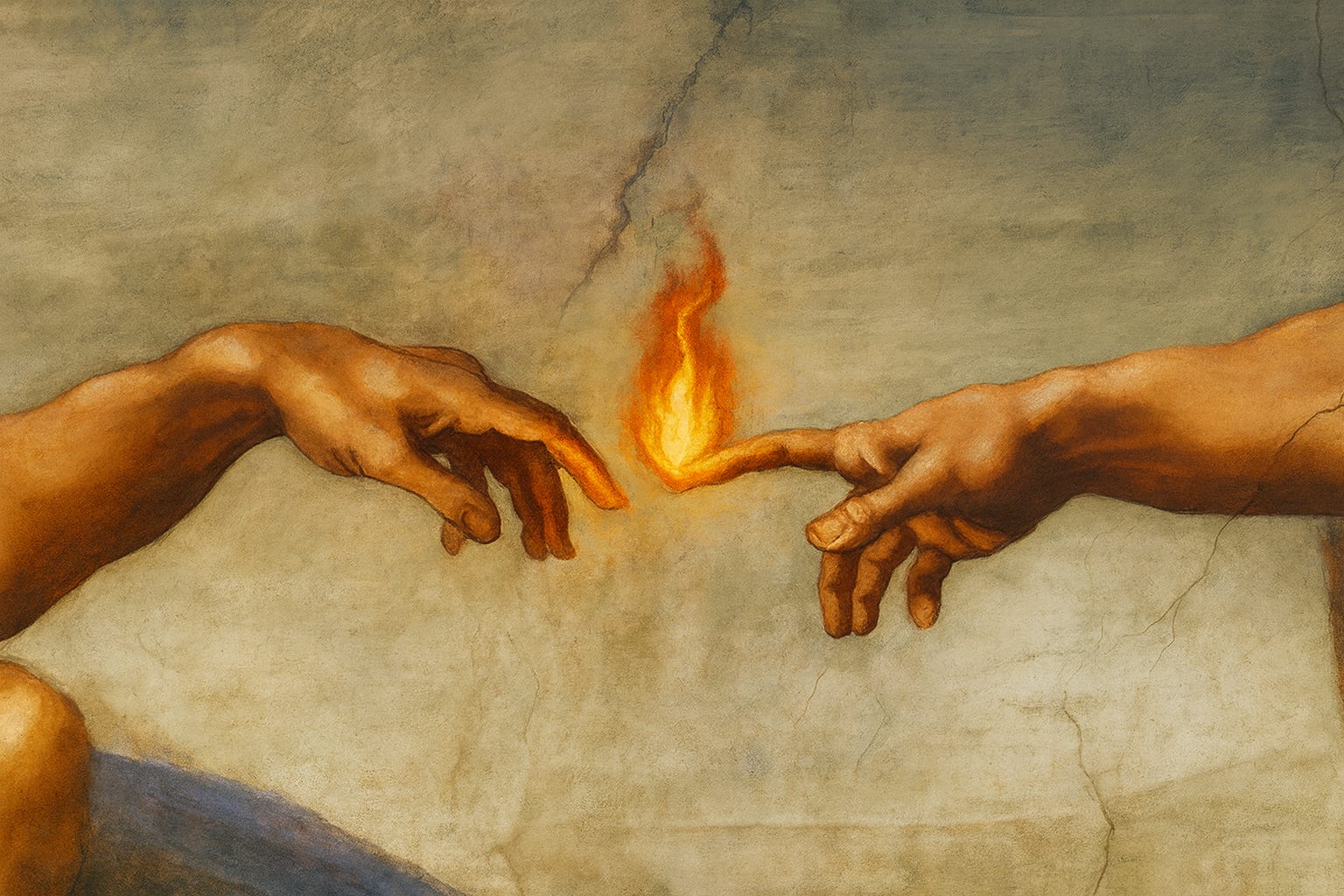
Humans are creatures of fire. The mastery of it is so deeply buried in our past that it is the stuff of mythology.
The ancient Greeks believed the Titan Prometheus stole fire from Mount Olympus and gave it to humanity, a crime against the gods so great he was condemned to be punished for eternity. This much of that myth is true: Homo sapiens did not capture fire, we inherited it. Some earlier hominin was our Prometheus.
Fire would have terrified and fascinated our distant ancestors as it raged across the land. Maybe it was the smell that enticed them on to the still-smouldering ground: of animals that could not outrun the flames and were cooked where they fell.
The scavengers came, first on wings, then on four legs, then on two. The pliant meat would have been a revelation to proto-human teeth used to ripping through raw flesh.
Perhaps a smouldering log was hauled back to the camp and the flame rekindled by fanning and feeding it. And one distant night long ago there was the first captured light that did not come from the moon or the stars, and warmth that did not come from the sun.
Until the rains came and doused it. Then, in the wet, cold, dark, the creatures would shiver in their fitful sleep and dream of keeping and controlling the light forever.
The next revelation might have come by chance. While toolmaking, a spark lit some dry grass and the secret of making fire was revealed. Fire became a possession. Fire gave them power.
Cooked meat became a staple. This unlocked more nutrition in the food and made digestion vastly more efficient. That fed the hominins’ energy-hungry brains. They grew to become human. In a very real sense, wise man, Homo sapiens, could also be called Homo ignis, man of fire.
Without fire we would not exist. And with fire we could exist in more hostile climates.
We carried fire out of Africa into colder regions that would have quickly killed us if we had journeyed without it. Cold has always been a bigger killer of humans than heat, and this migration came during the last ice age, when global temperatures were about 6C colder than today and sea levels around 120m lower. We are still living in the tail end of that era.
On our journey we encountered other hominin travellers who also had captured fire. We outcompeted them, but their memory is still etched in our DNA.
We pushed north to the edge of the Arctic, clinging to life on a brutal frontier possible only with fire. Some continued to walk across the land bridge where the Bering Strait lies today, into North America, then all the way to the tip of the southern continent.
There was another, earlier, migration north and then east: across India, through Indonesia, to the rim of an ocean. Then, some believe, came a remarkable and long-forgotten journey by boat, perhaps chasing the smoke the travellers could see rising over the horizon. They set foot on Sahul, the continent that is now New Guinea, Tasmania and mainland Australia.
With firestick farming, these first people transformed an entire continent. Across tens of thousands of years Australia’s plant and animal life evolved in response to routine burning, creating a human-influenced ecosystem unique in the world. Some wattles need heat or smoke for their seeds to germinate. Gums carry buds beneath their bark that can sprout quickly after fire has stripped their canopy. Their leaves contain flammable oils that help fires spread, clearing out less tolerant plants.
Fire shaped modern humans, and the First Australians used fire to shape this land.
Cast across all peoples and all lands, human progress was tied to fire and food, bounded by what the land could yield. Energy in calories fed human and animal muscle, and wood fed the flames.
Hominins controlled fire by about a million years ago. The availability of wood set limits on growth. Wind and water power also made contributions to this pre-industrial economy.
Progress was glacially slow. From the first year of the common era to 1800, total world output rose several-fold, on the order of six times, but most of that merely kept pace with population; average incomes changed little.
Vast forests were felled to meet the energy needs of a growing population. England’s expanding demand for fuel and the mounting cost of scarce woodland pushed people toward coal from the late 1500s. By 1650, coal was well established, especially in London. Coal is denser than wood and burns hotter, opening new possibilities for industry.
The pace of growth quickened when coal was used to boil water to make the steam that drove the wheels of industry. It pushed trains across the land and ships across the sea. The muscle power of man and beast was replaced with furnaces and pistons.
Between 1800 and 1900 the size of the world economy roughly tripled.
My grandfather, Allan Uhlmann, was born in 1899 in a house on the outskirts of Brisbane with no sewerage, no electricity and no running water. There were no cars on the streets and no planes in the sky. Yet he arrived on the cusp of another fossil-fuel revolution.
Oil, the lightest and most potent fuel of its age, powered an explosion of growth unmatched in human history.
When Allan died in 1967, there was a Ford Zephyr in the garage, a television in the lounge, a fridge in the kitchen and a flush toilet out the back. Two years later the Americans landed men on the moon. In Allan’s lifetime he could have met the Wright brothers and Neil Armstrong. Life expectancy had risen sharply with modern medicine, child mortality had collapsed, and wealth had expanded on a scale no generation before him had known.
By the year 2000 the world economy was about 19 times larger than in 1900.
Wealth is the shadow cast by energy. Rich nations are energy rich. Rich people are energy rich. Poor nations and people want to be rich. Your lifestyle is measured in the heat you can afford to waste. The average Australian commands as much energy each year as about 70 people pedalling bicycles, day and night, seven days a week. That is around 10 times more power than the equivalent person in 1800.
At the dawn of the 19th century, the whole world ran on about 25 exajoules of energy a year, almost all of it wood and muscle. We now burn through that every fortnight. In two centuries our energy use has exploded nearly 30-fold, and with it everything we call progress.
We live in the world fossil fuel built. Everything made has coal, oil or gas embedded in it. And here’s the rub: humanity burns more wood now than in 1800.
There is no energy transition. Every new fuel has been an addition to a pile that grows ever higher. Wind and solar add only a sliver to that pile and will never be the dominant source of primary energy. We are, and will remain, creatures of fire.
Please forward to your ex employer the ABC. When I hear they cost the Australian taxpayer $1 billion a year I laugh. They will end up costing us $1 trillion and our enviable living standard in short time … at the very least be substantially responsible. They have pounded the case for ‘net zero’ ever since it became a ‘thing’ to a point in which politicians are too afraid to do back their own convictions.
We sell our coal to China cheaper than we should because we don’t use it. They build ‘ghost cities’ and ‘roads to nowhere’ because of it. Result more carbon emissions not less. We export or uranium but we can’t use it… as if we’re living on another planet!
And, when you forward this to the ABC pls add a subscription to ‘Doomberg’ … I’ll even pay for it.
Ps. Doomberg follows you work.
I agree. The elephant in the room of human progress is access to cheap energy that, when not used directly to create warmth or power engines, can be converted to electricity that can be conveyed by wire to drive motors that drive transportation and magnify the creativity of man.
The test of the utility of a source of energy is whether it will be employed in the absence of a subsidy from the public purse.
As for the climate, there is such diversity. We have lots of choice.
As for the so called average climate, our ability to measure the change in the temperature of the air at ground level accurately and comprehensively remains in doubt.
The change that we see from day to night, from winter to summer and from year to year exceeds by far the degree of change that, if our measurement were indeed to be correct has occurred over the period of a hundred years.
The back radiation argument is falsified by the unequal rates of warming and cooling of the two hemispheres over time. The atmosphere is well mixed.
The 'chicken little' alarmists should be disregarded.