


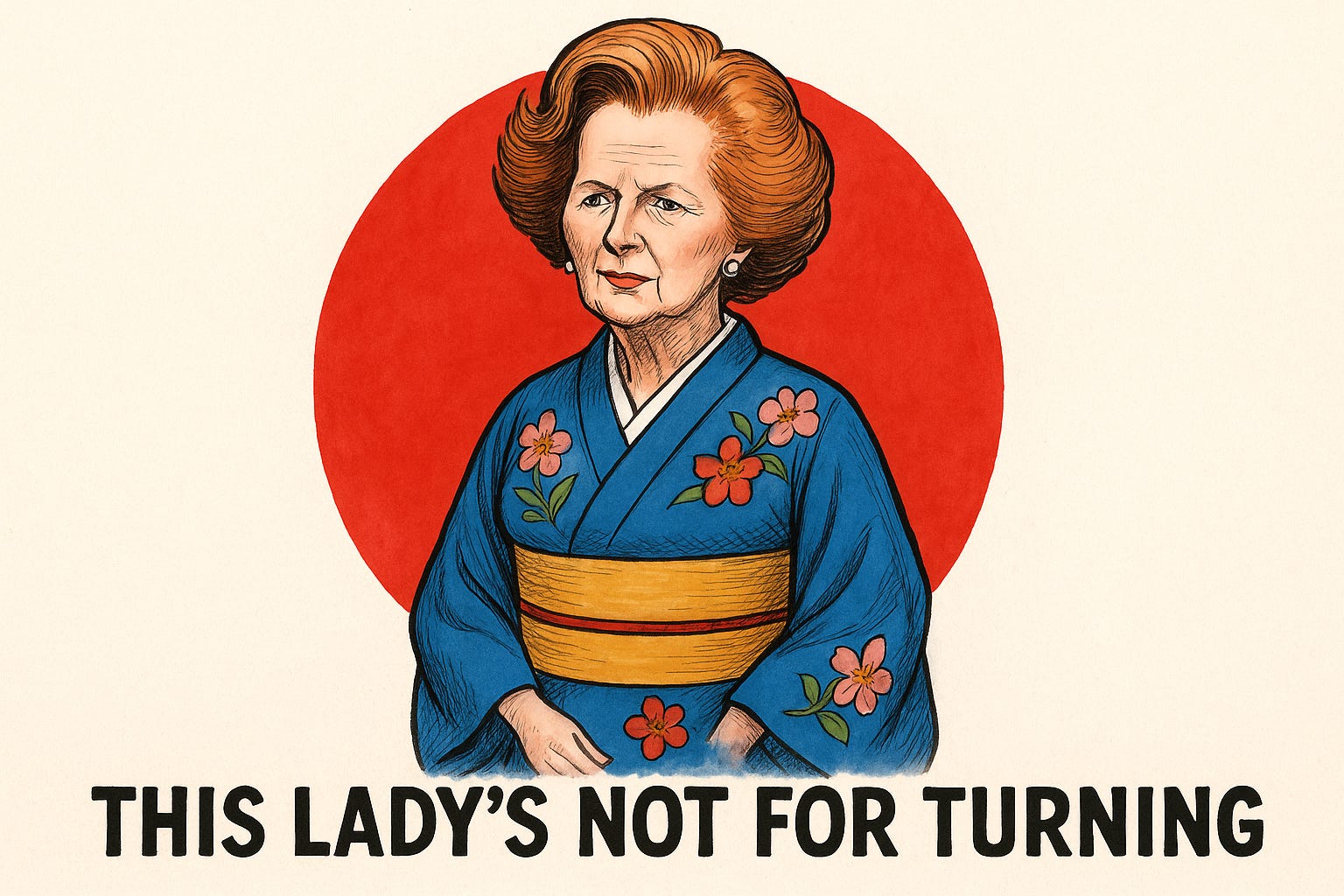
“Power is like being a lady… if you have to tell people you are, you aren’t. — Baroness Margaret Thatcher
Japan is about to appoint its first female prime minister, Sanae Takaichi. The media will undoubtedly fixate on that milestone, but for a professed admirer of former UK prime minister Margaret Thatcher, gender is the last thing Takaichi will want to define her legacy.
Entering politics in her early 30s, Takaichi devoted herself to understanding policy rather than joining her male colleagues who frequented the Ginza cabaret clubs at night. Perhaps she will coin a new adage — if you don’t want to join them, beat them. She has considerable expertise in national, cyber and energy security, as well as economic and industrial policy, and knows more than most of her senior bureaucrats.
Paraphrasing her victory speech as newly elected president of the Liberal Democratic Party (LDP), she declared: “Forget work–life balance. We have a huge agenda ahead of us. I for one will not be resting, and I expect you to do as I do.” Politicians are often accused of talking out of both sides of their mouths, but it was hard to take her words as anything other than authentic.
Some pundits believe the old guard of LDP men will try to pull her down, but her predecessor, Shigeru Ishiba, lost both upper and lower houses during his recent term — the first time in the party’s 70-year history. The LDP had been on the nose for many reasons, most notably a political donations scandal involving multiple members of the Abe faction under former prime minister Fumio Kishida. As a result, there has been considerable tension with the LDP’s coalition partner, Komeito. Restoring unity will be one of Takaichi’s early missions.
So who is Sanae Takaichi?
For starters, she is a hardline conservative who believes in a “Japan First” agenda and supports Abenomics — aggressive monetary easing, bold government spending and structural reform — unsurprising given she belongs to the late Shinzo Abe’s faction. Woke politics is not on her agenda. A staunch traditionalist, she firmly supports male-only succession to the Imperial throne, an unbroken line since Japan’s first emperor, Jimmu, in 660 BC.
Takaichi is a China hawk who supports Taiwan’s sovereignty and wants to build a regional security alliance to back its independence, warning that an invasion by China would be a “life and death” issue for Japan. Like Abe before her, she advocates revising Article IX of the Constitution to allow Japan’s Self-Defence Forces to strike first if necessary, rather than only in response to attack. She also supports lifting defence spending to 2 per cent of GDP and placing US nuclear assets in Japan during times of crisis — with good reason.
Japan’s Ministry of Defense stated in its 2024 Defence White Paper that scrambles to intercept Chinese military aircraft by the Japan Air Self-Defence Force surged from 96 in 2010 to 464 in 2024. While below the 2016 peak of 851, Japan’s security environment has dramatically worsened. Russia has also become a serious concern, with scrambles to intercept Russian aircraft rising 36 per cent to 237 in 2024. Of greater concern is the joint surveillance operations Russia and China have conducted since 2019.
All told, since 2010, the ministry has recorded almost 12,000 scrambles to intercept Russian and Chinese aircraft near Japan’s borders — more than twice a day.
At sea, the picture is little better. The number of sightings of Chinese combat ships and aircraft carriers around Japan’s south-western islands and the Soya and Tsugaru straits jumped from three in 2010 to 52 in 2024. Last year, Chinese Coast Guard vessels were active in the contiguous waters around the Senkaku Islands for 355 days, with 1351 vessels recorded — both record highs. 2025 is already on track to exceed those levels.
Like Abe, Takaichi has been a regular visitor to Yasukuni Shrine, where Class-A war criminals are interred — a move that continues to anger Japan’s former wartime enemies.
For Australia, energy will be the first test of how Prime Minister Takaichi deals with her allies.
It was interesting to hear Resources Minister Madeleine King assure Japan it had “nothing to worry about” from the Albanese government over LNG approvals in the North West Shelf at last week’s Australia–Japan Business Cooperation Committee conference in Perth. That may be so, but one of Takaichi’s closest confidants is former Japanese ambassador to Australia Shingo Yamagami.
Foreign Minister Penny Wong was reportedly behind Yamagami’s early recall by Japan’s Ministry of Foreign Affairs, following his outspoken criticism of China’s “wolf warrior” diplomacy. Yamagami has also been sharply critical of Australia’s energy policy, accusing governments of creating uncertainty and unpredictability for Japan. He famously lambasted Queensland’s royalty hikes on coal without consultation, publicly chastising the Palaszczuk government for its lack of respect towards a long-standing ally.
As the former NSW senior trade and investment commissioner for Japan, I shared many engagements with Ambassador Yamagami, all of them constructive. In February 2023, we successfully secured exemptions for Japanese coal miners with evergreen contracts from the NSW coal reservation scheme, after bureaucrats were reminded — by their own trade envoy — that such intervention would damage trust. At the time, NSW Treasury seemed oblivious to Japanese concerns about meeting contractual obligations with end customers, wrongly assuming miners could simply “grin and bear” higher costs because they were enjoying super profits.
If Yamagami advises Prime Minister Takaichi on Australia and energy, expect hard conversations that expose Canberra’s political complacency. For all the diplomatic niceties at bilateral conferences, Australia is fast losing its reputation as a safe jurisdiction. Some Japanese corporations now view us as a political and sovereign risk. Having raised these inconvenient truths alongside Yamagami for years, I can attest our federal and state governments remain tone-deaf.
At the same AJBCC conference, one Japanese coal major said Australia’s regulatory environment had become so absurd that its new investment priority would shift to Vietnam once its Australian mines were exhausted.
The Japanese rarely vent frustrations publicly. When they do, it’s the corporate equivalent of DEFCON 2 — and we should treat it as such.
Prime Minister Takaichi will be Australia’s wake-up call. We will quickly learn that our arrogant belief Japan needs us more than we need them is misguided. If Australia fails to underwrite Japan’s energy security, we threaten her national security. The new Iron Lady of Japan will demand action — and she will likely be gravely disappointed, especially as the Albanese government continues to appease her greatest regional threat.
In the immortal words of Margaret Thatcher, Prime Minister Takaichi might well be thinking: “If you want to cut your own throat, don’t come to me for a bandage.”
Michael Newman has four decades of business experience in North Asia and served as NSW’s Senior Trade and Investment Commissioner to the region.
https://jp.linkedin.com/in/mike-newman-3896b810

Sounds like we need our own version of Takaichi down under. From reading this she is no fool, has a clear agenda and is long on the necessary government experience to deal with bureaucratic bumpf should it attempt to get in her way. The other half of this article should worry us greatly: our rapidly declining global reputation as either a reliable ally or sound investment and business partner. Let's face it: we are on the nose with Trump and his administration, with Japan, with certain Pacific Ocean island nations, and most likely with a number of political heavyweights in UK and Europe. The sign-off about cutting one's own throat is indeed prescient. Wake up Australia.
Australia is stupid.