


In Public Disservice (June 2025), it was established that Australia has the world’s most bloated bureaucracy. The Australian Bureau of Statistics (ABS) has just released the latest data for 2024–25. We now have 2.597 million public servants—an increase of 80,000, or 3.2 percent in a year—across federal, state, and local governments.
This is costing us A$249.5 billion per annum, or 7.5 percent more year on year. Since the 2022 federal election, the federal public service has grown 14 percent, or 46,600 employees. Last year alone it surged by 20,500, or 5.6 percent. Since COVID-19, the ranks of bureaucrats have exploded by 54 percent, or 135,100, at the federal level.
Multiple federal departments were recently exposed for exceeding staffing budgets by A$841 million in 2024–25. Nobel laureate economist Milton Friedman famously observed that people are far less careful when spending other people’s money.
Average federal public sector salaries are costing an extra A$3.54 billion per annum, or 9.5 percent more than in 2023–24. That brings the total wage bill to A$40.86 billion—almost double the level before the pandemic.
One might ask exactly what is being brought to the table by these battalions of extra bureaucrats behind so many of our onerous regulations. Is it any wonder we have squandered so much of our natural competitive advantage?
Harvard University’s Economic Complexity Index (ECI) measures the productive capabilities embedded in the economic activities of countries. It ranked Australia 105th out of 145 nations in 2025, down from 70th in 1998. We are now ranked behind Yemen, Iran, Uganda, and Pakistan—and over the next decade we are expected to slip to 137th place. Just an anomaly?
Despite the fanfare around the recent critical minerals cooperation with the United States, the Fraser Institute’s Mining Attractiveness Index—the global mining industry’s gold standard—places New South Wales, Victoria, and Tasmania in the bottom quartile, behind the Democratic Republic of the Congo, Zimbabwe, and the Ivory Coast. The Americans will quickly discover this.
Australia ranks 29th out of 38 OECD nations for corporate tax competitiveness.
In 2024–25, the federal Department of Climate Change, Energy, the Environment and Water (DCCEEW) wages bill was A$70 million over budget, with consultants pocketing an additional A$47 million to reverse-engineer the chosen narratives. Yet our energy system is more chaotic than ever.
The states are no better when it comes to endless hiring. Collectively, state and territory public service ranks have grown by 2.8 percent over the previous year to 1.993 million, or 20 percent since the pandemic.
Average expenditure on state and territory salaries over the past year was 7.1 percent higher, and 31.2 percent higher since COVID-19. States and territories shelled out A$191 billion in 2024–25, with an average salary across state governments of A$96,000.
Earlier this year, Victorian Premier Jacinta Allan promised a headcount reduction of 3,000 public servants because of the troubled state of the budget. In 2024–25 it turns out she added 7,200 people, costing Victorians A$2.7 billion more. Why bother belt-tightening when the Commonwealth Grants Commission has her back? Just wait for the surge in new hiring to support new departments on the back of the recent Treaty legislation.
New South Wales Premier Chris Minns should be lauded for modernising planning laws to accelerate approvals, claiming the moves would save taxpayers A$29 million. However, his public service wages bill has surged 5.9 percent, or A$3.1 billion more than in 2023–24. He’ll need another 107 examples like that to achieve a net saving worth bragging about.
Table 1: Growth in Net Debt by State as % of Gross State Product (GSP)
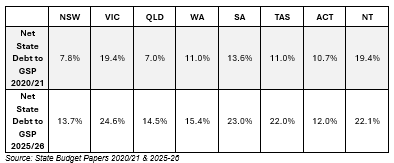
State debt is ballooning — and so are the interest payments that come with it.
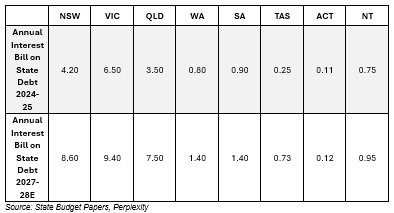
In aggregate, Australian states are projected to spend over A$30 billion on interest payments alone in 2027–28 — an increase of A$13 billion compared with 2024–25.
Table 2: Annual Interest paid on State Debt (A$ billion)
Local councils are following the same trend. There were 4,500 new hires year on year and 27,200 since COVID-19 ended. Instead of focusing on relatively static core functions—bin collection, park maintenance, and expediting development approvals—they are now costing taxpayers A$17.6 billion, an increase of A$1.13 billion, or 7 percent more than the previous year. Since the pandemic, that bill has ballooned by A$3.4 billion.
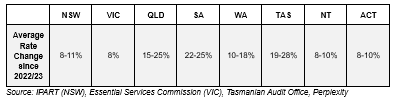
Over the past three years, local council rates have risen across every state and territory.
According to the Queensland Audit Office, 62 percent of local councils were deemed at moderate to high risk of financial unsustainability in 2024. Yet Queensland councils added another 700 staff in 2024–25.
North Sydney Council joined the ranks of the financially unsustainable after the cost of redeveloping its iconic Olympic Pool doubled from initial estimates. The council decided residents should foot the bill—imposing an 87 percent rate hike to pay for its own mismanagement.
Table 3: Local Council Rate Increase by State/Territory since 2022/23
It seems that council mergers should be back on the table to rein in this waste.
Public sector employment in public administration across all levels of government has surged by 31,200 positions in the past year, reaching 880,600. That workforce now costs taxpayers A$90.2 billion per annum—up 8.1 percent year on year—and represents 36 percent of total public sector salaries and 34 percent of all public sector employees.
It’s worth noting there are now more administrators than there are people working in education and training (768,300) or health and social services (668,700).
Can our political leaders please explain exactly what all these additional administrators do—other than make our lives more difficult?
Australians need to wake up to the reality that the ever-expanding size of our unelected bureaucracies at every level of government is out of control. It is simply unsustainable.
To quote Thomas Sowell again: “Elections should be held on April 16 — the day after we pay our income taxes. That is one of the few things that might discourage politicians from being big spenders.”

Terrific piece, thank you Chris. And in the real world, alarm bells keep going off indicating that Australian business is in big trouble eg:
- 2022‑23 (7,942) vs 2021‑22 (4,912) : insolvencies rose by ~62%
- 2023‑24 (11,049) vs 2022‑23 (7,942) - another increase of 39%
- FY 2025 : for the first 8 months of FY 2024‑25, increase of 42.6% from the first 8 months of FY 2023‑24.
https://www.asic.gov.au/about-asic/corporate-publications/statistics/insolvency-statistics/
I can’t help but think our leaders are like drug addicts. No self awareness of their actions and just downhill all the way. Not sure what you would call the drug though.