


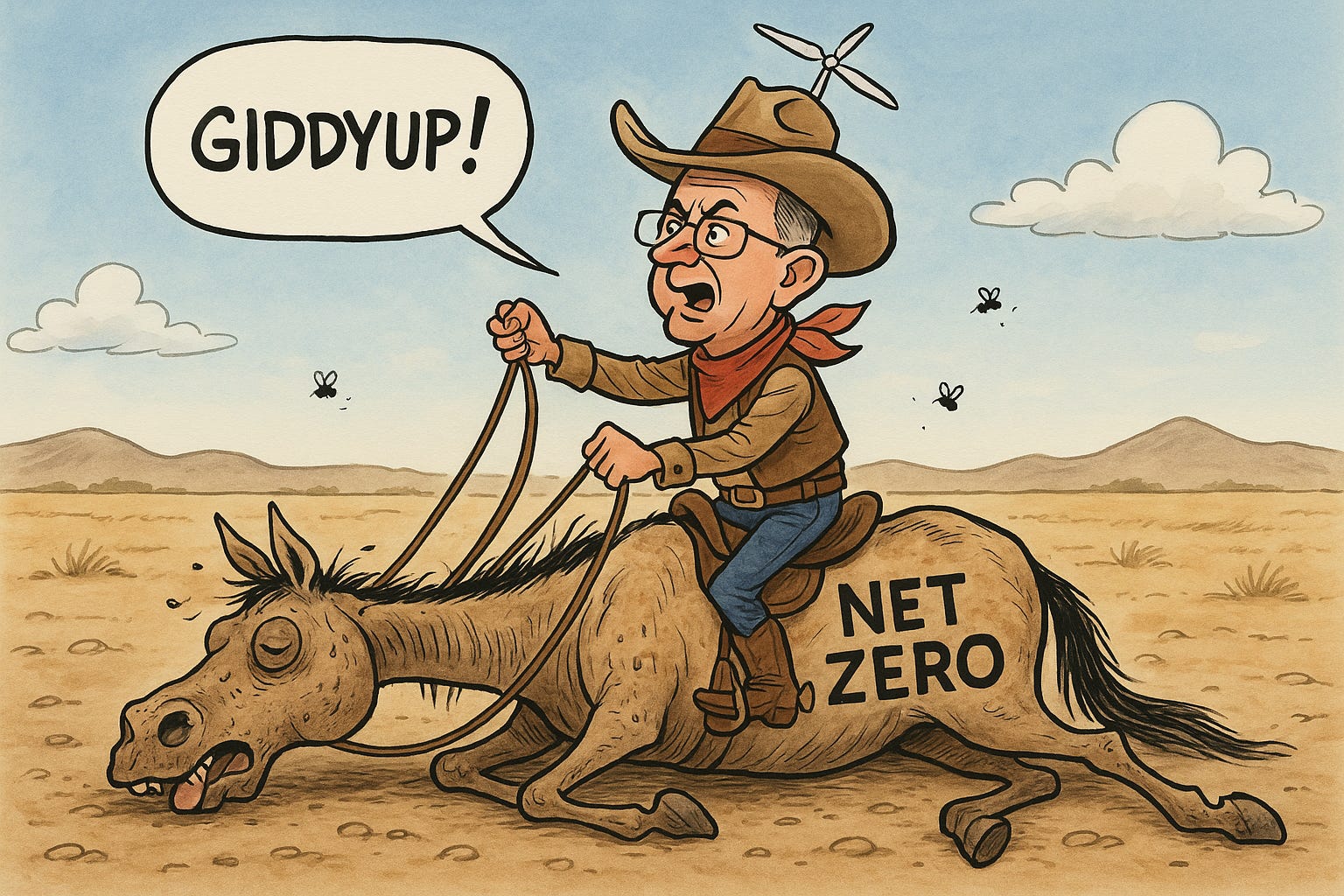
“Dakota tribal wisdom says that when you're on a dead horse, the best strategy is to dismount. Of course, there are other strategies. You can change riders. You can get a committee to study the dead horse. You can declare that it's cheaper to feed a dead horse. You can harness several dead horses together. But after you've tried all these things, you're still going to have to dismount.” ― Gary Hamel
The net zero gravy train in Australia has been a powerful magnet, drawing in every conceivable type of wannabe to the climate space—from government departments, universities seeking grant funding, rent seekers, and even those wanting to sound sophisticated at Surry Hills cocktail parties. Corporates, not wanting to be seen swimming against the tide, felt compelled to hire productivity-sapping chief sustainability officers, who advised boards on the imperatives of enforcing paper straws and branded keep cups at work, to comfort shareholders in annual reports that they were committed to saving the planet.
It is, however, important not to conflate participation in the climate crusade with possession of useful scientific knowledge—beyond platitudes—let alone an understanding of the commercial complexities involved in executing the renewables transition.
Pretending to embrace climate ideology is a favourite pastime for many zealots.
Take Zali Steggall OAM’s electorate of Warringah as a good example. In her first campaign she ran on a climate-alarmist ticket and, upon winning the seat, encouraged households to sign up to her “Roadmap to Net Zero” plan. Constituents could pledge their personal sacrifices to cut emissions. Fewer than two percent bothered to register. The page no longer exists.
A simpler real-world study yielding the same result might have been to cruise down Military Road, Mosman, on a Saturday morning. Scores of turbo-powered, gas-guzzling luxury European SUVs line the streets as local residents drop off their laundry and sip oat milk cappuccinos while booking the annual three-week family ski holiday to Hakuba in Japan—between bites of exotic-sounding gluten-free vegan muffins.
While personal consumption habits are the most reliable barometer in assessing one’s true fears about global warming, there can be no doubt there is growing anxiety amongst the alarmists, who can feel the inevitable catastrophic derailment of net zero right before their eyes. The evidence is becoming all too clear.
The latest signals from the United Nations (UN) reveal this traumatic realisation.
President Donald Trump has exposed the only language the parasites at the UN understand—securing funding from hosts. Trump made it clear in February 2025 that:
“some of the UN’s agencies and bodies… act contrary to the interests of the United States.”
He has slashed the United States’ contribution to the UN Secretariat budget by almost 90 percent and eliminated funding to multiple groups, including the Intergovernmental Panel on Climate Change (IPCC) and the UN Framework Convention on Climate Change (UNFCCC). He has also banned US taxpayer-funded scientist participation at UN events. Headcount reductions of 20 to 30 percent are expected from 2026 across UN agencies. This is deeply relevant because the signal is spilling over to the private sector.
Major financial institutions—JP Morgan, HSBC, UBS, Mitsubishi UFJ, Goldman Sachs, and Macquarie, to name a few—have had their Spartacus moment. They’re freeing themselves from the bondage of the Net Zero Banking Alliance (NZBA). The NZBA was established in April 2021 under the United Nations Environment Programme Finance Initiative (UNEPFI). All joined it for the selfish purposes of avoiding public censure in the media and exploiting rent-seeking opportunities. Now that net zero is effectively redundant, there is no need to keep up the facade. Bank lending to fossil fuel companies in 2024 alone was US$870 billion. The 2025 run rate is already 23 percent higher than that. Follow the money.
That is why the UN is pulling out all the stops to raise alternative pools of capital to address the looming shortfall. It is mission-critical to its own survival.
Take the UN International Court of Justice (ICJ). It recently made a landmark decision that will allow countries to sue others for not properly addressing climate change—or, in other words, to enable wealth transfers from capitalist first-world countries to those less fortunate, irrespective of the validity of the alleged causes. Unless, of course, you happen to be China, where developing-nation status grants an endless supply of “get out of jail free” passes. Presumably, there will be an expectation that successful plaintiffs will “voluntarily” recycle some of the awarded damages to the ICJ to allow it to continue its self-righteous purpose.
So desperate is the UN that it flew UNFCCC Executive Secretary Simon Stiell to Australia, presumably to secure the deposit for the COP31 summit in Adelaide. Nobody took his dire prediction—that mega-droughts will mean fruit may be a once-a-year treat if we don’t “go big” on our 2035 targets—seriously. For a man who backed fossil fuel investment when the environment minister of Grenada, it is not hard to see through the wafer-thin veneer of the UN—something even our own energy minister begrudgingly conceded.
Not to be outdone, Climate Change Authority Chair Matt Kean has been feverishly writing op-eds pointing to the dangers of global warming to the health of the Great Barrier Reef, the algae bloom in South Australia, and of course, President Trump—who, apparently, will make it even harder for Australia to forecast bushfires, floods, and heatwaves. Trump Derangement Syndrome aside, given the untrammelled access afforded the vassal state of Australia in Beijing, it is not hard to see why President Xi escaped censure as the world’s largest emitter.
Incidentally, while the Liberal Party number crunchers continue to dither on what position to take with respect to net zero (apparently to be decided by December), they need look no further than the incendiary comments made on the former state Member for Hornsby’s X account. Nobody is buying it. It’s unambiguous.
Switching back to the real world, where is the New South Wales Opposition’s outrage directed at EnergyCo, demanding answers as to why the cost of the Central West Orana Renewable Energy Zone (CWO REZ) is expected to leap 8.5 times the original forecast? Expanding the output will be one pithy excuse. Inferior modelling is the honest answer.
In Queensland, the CopperString transmission project saw costs explode from the initial 2021 estimate of $1.5 billion to $14 billion today. How could this be? It has been attributed to a failure to include key network connections to mining and renewable energy projects in the initial scoping and costing for upgrades from 330 kilovolts (kV) to 500 kV in certain sections. You know, just the itty-bitty details that the project was supposed to be originated upon. Honest mistake?
Same for the Marinus Link Interconnector between Tasmania and Victoria, which has seen the original cost of $3.3 billion revised 50 percent higher as the cost of undersea cables surged.
The most egregious example is the Victoria–NSW Interconnector (VNI) West project, originally costed at $1.8 billion but now forecast to blow out to as much as $11.4 billion. Instead of firing those responsible for such incompetent modelling, no accountability is being taken.
Perversely, Victorian politicians and bureaucrats have such a sense of entitlement that, despite these failures being a function of having no grasp of commercial metrics, they intend to introduce draconian legislation which will ignore private property rights and provide Premier Jacinta Allan’s goons access to rural land—and worse, slap owners with $12,000 fines for non-compliance.
That the Victorian Liberals can’t prosecute an “if it can happen to them, it can happen to you” campaign on the back of such a lay-up is even more frightening. How mediocre do they have to be to lag in the polls to such a woefully inept government?
Offshore wind projects in the Hunter and Illawarra have fallen over after leading front runners Norwegian firm Equinor and its Australian partner Oceanex declined to submit a formal application for a feasibility licence. To add insult to injury, Germany’s most recent offshore wind auctions attracted zero bids. Zero. Without heavy subsidies there is no private interest. Who knew?
Centre for Independent Studies analyst Aidan Morrison wrote an extremely damning piece pointing to how a fund chaired by former Labor Prime Minister Julia Gillard AC acquired a wind farm project just six days before Labor Energy Minister Chris Bowen underwrote the revenues under the Capacity Investment Scheme. Despite emphasising no evidence of any illegal or improper activity, he wrote what most ordinary Australians are thinking:
“if this is what the future of ‘clean energy’ looks like in Australia, it looks absolutely FILTHY.”
Then there are grid-scale batteries. We are told these “shock absorbers” will save us—which begs the question: who thought introducing shock absorbers to a system that never required them in the past was a prudent idea? And at what cost?
The results have been disastrous. Despite having more grid batteries than ever, the average cost of their energy discharge provision doubled to $478 per megawatt hour (MWh) according to the 2025 Australian Energy Market Operator (AEMO) Quarterly Energy Dynamics Q2 Report. Yet that did not stop government agencies like EnergyCo shouting from the rooftops that half of the $1.1 billion Waratah Super Battery had been completed—even though it will have a maximum of two hours’ duration when finished.
These examples prove time and time again that state and federal governments alike have backed themselves into such a corner on renewables that admission of failure exacts too big a toll on their survival. Whichever way you cut it, their only solution is to up the ante on the current plan, expand overreach powers, and think somehow voters will put their trust in them that they know better. Everyday Australians are seeing through the smoke-and-mirrors show and know they will inevitably pick up the tab through higher taxes, steeper energy prices, or most likely both.
To be honest, we should have been paying closer attention to financial markets—which have been forecasting the demise of net zero for many years.
Prior to the Global Financial Crisis (GFC), generous renewables subsidies paid for by low interest rate–fuelled government debt led to massive overcapacity. When the GFC eventually tanked the world economy, fiscally overdrawn governments with excessive budget deficits had to take away the feed-in tariff punchbowl, sending 40 major renewables stocks to the wall. By 2012, even the solar and wind industry bellwethers experienced 95 percent declines in market value.
So should we feel a sense of déjà vu that Chinese solar giants, which dominate 90 percent of global supply, shed one-third of their workforces last year and absorbed over US$60 billion in losses? Once again, government subsidies have created massive solar overcapacity—meaning 2025 could eclipse last year’s woeful record. Shares in Chinese solar giants Trina, JA Solar, and Longi Green Energy are trading at least 75 percent lower than they were several years ago. Sounds familiar, doesn’t it?
Alarmingly, despite such dire fundamentals, Energy Minister Chris Bowen stated that the “government believes” there is space for growing a domestic solar industry. Another $34 million to create fifty new jobs. That’s how we get a “Future Made in Australia”—via more of our tax dollars. $680,000 per job.
The most liquid global financial market exchange-traded funds (ETFs) in wind and solar have also chronically underperformed over the past five years, while nuclear- and fossil-fuel-focused ETFs have soared.
Given that the rest of the world is disembarking before the net zero gravy train derails completely, it is concerning that Australia is stubbornly sticking to its guns in a vain attempt to stop the 0.0000167 percent of the atmosphere we actually pollute.
The Climate Council knows it too. In a hysterical bid to get useful idiots to do their bidding, it posted on LinkedIn:
“Repealing net zero is a recipe for climate catastrophe. It would supercharge climate disasters, spell the death of the Great Barrier Reef, and unleash economic chaos. Unchecked climate change could cost Australia $4.2 trillion by 2070, and make 50°C days the new normal in Sydney and Melbourne.”
Seriously?
For as much as the Climate Council self-appraises its climate scientific prowess, it clearly cannot see that net zero is actually the very recipe already unleashing economic chaos.
Advocacy for this pagan weather-bending zealotry has already:
delivered an economy that has seen per capita GDP decline for nine out of the last eleven quarters;
pushed electricity prices 32 percent higher than three years ago;
sunk national productivity to a six-decade low;
cut living standards equivalent to those experienced in 1959;
caused insolvencies to hit record highs, with manufacturing, mining, and construction sectors bearing the brunt of the hollowing out;
created budget deficits predicted to continue for the next four decades; and
meant 82 percent of jobs created in recent years are either in the public service or rely on government funding—five times the normal rate.
Our politicians tell us we are a critical minerals superpower. The latest Fraser Institute global mining survey revealed that no Australian state is in the top 10 for investment attractiveness. NSW and Victoria rank below the Congo, Zimbabwe, and the Ivory Coast, languishing in the bottom quartile. Investors clearly think otherwise.
Our publicly listed Australian Securities Exchange (ASX) has seen a decline in net listings since 2022. From a record high of 2,158 companies listed in June 2022, in March 2025 it stood at 1,960. Put simply, we are not seen as an attractive investment destination—not helped by the ASX governance team making a recommendation to require board directors to report sexual orientation and religious beliefs. Successful exchanges go out of their way to minimise transaction costs. The ASX clearly thinks woke ideology is a higher-order priority.
In March 2023, the Business Council of Australia (BCA) published a report showing a domestic investment drought. New business investment as a percent of GDP at the time was around 11 percent—levels not seen since the severe recession of the early 1990s. We are still languishing at these lows.
While media outlets report that global instability, inflation, and interest rates have been factors, the truth is businesses invest because they see a cycle, not because credit is cheap. In Australia, 30,000 insolvencies over the past three years prove the cycle is bleak.
The economic implications of slavish devotion to the net zero religion could be the time bomb that unravels our property market.
The value of Australia’s real estate stock currently sits at 415 percent of GDP. Japan, at the peak of its 1980s property bubble, was 581 percent. Canada and New Zealand peaked at 400 percent around three years ago. Housing indices in those markets have declined 16–20 percent since. Do we honestly think Australia is immune?
Sydney property prices sit at 14.4 times average income. Tokyo at its peak was 15 times. Japanese banks had 41 percent of the loan book as mortgages before the collapse. The Australian Prudential Regulation Authority (APRA) reports our banks are at 65 percent.
It took Japan two decades to recover after writing off non-performing loans (NPLs) worth 20 percent of GDP. While it is true Australian bank NPLs are benign (1.1 percent), financial markets rarely behave like the stress tests forecast—meaning confidence can erode in a heartbeat.
We were fortunate to escape the worst effects of the GFC in 2008–09 thanks to the fiscally prudent Howard–Costello years and a China commodity boom which kept our unemployment rate under 6 percent. We have no such buffers now.
The longer it takes the Opposition to offer major differentiation—with authentic conviction—to repudiate net zero, the longer we will remain hapless bystanders watching an emboldened government, which arrogantly believes it has an unassailable mandate, continue to ignore reality, misallocate taxes, and guarantee a path to ruin.

Bulls-eye: Mike, you are absolutely on-target. In fact, you’ve hit so many targets in this single report that it looks like carpet bombing! It is hard-hitting, and should be heavily and permanently bruising in certain sectors. Every voter in the country should read and understand this statement, but what is the point when the voting options are shabby and next to worthless? Still, we can only hope for seriously beneficial change, sooner or later… can’t we? A special thank’s to Chris for hosting commentary of this quality.
All so stupid. Of course living standards collapse when you pump up land prices to infinity via near zero interest rates for years and refuse to use cheap coal and gas. Net zero is a religion like a slow motion Jim Jones cult.