


An American friend asked me why Australian politics appear stable relative to the rest of the world, given how steeply our living standards have fallen. My on-the-spot answer was that we started from such a height that even after a major downturn, Australians still consider themselves lucky. And though our politics appear relatively stable for now, populist energies are growing from a sense that our luck has run thin, and that we’re led by people who rely on it.
“One of the central questions for Australians is whether the conditions that produced so much happiness and success have also weakened the nation’s adaptability and slowed its reflexes of survival.” Donald Horne, The Lucky Country
To call Australia “the lucky country” is to invoke a cliché drawn from Donald Horne’s 1964 book. The Lucky Country offers a sprawling portrait of Australia during the boom years, when we were perhaps the most evenly prosperous nation in the world. Horne describes a land of plenty, with “more savings accounts than people”, where cars and TV sets were abundant, and around 70 percent of the population owned their own home.
He described his countrymen as a practical people, open to change but not easily led. There was something in the sceptical cast of the Australian psyche that kept us resistant to ideological fervour. We regarded our politicians as managers hired to ensure everyone got a “fair go”, and let them go about their business with little interest or oversight.
He thought Australians lived under a false accusation of laziness, though we didn’t always take work as seriously as our leisure. Borrowing an observation from the English historian J. A. Froude, he captures something essential about the Australian way of life. “It is hard to quarrel with men who only wish to be innocently happy.”
The book flips back and forth between a paternal fondness for the Australian people and a scorching critique of their leadership. Even the title, The Lucky Country, was coined as an ironic dig at Australia’s political class, which makes it faintly comic that so many of the politicians Horne would have mocked now use it as a patriotic slogan.
“Australia is a lucky country run mainly by second-rate people who share its luck. It lives on other people’s ideas, and, although its ordinary people are adaptable, most of its leaders (in all fields) so lack curiosity about the events that surround them that they are often taken by surprise.” The Lucky Country
Australia worked well despite its elites, Horne argued, and our prosperity came from a vast resource endowment, inherited British institutions, American ideas, and the practical competence of ordinary people. He accused the Menzies government of muddling around while projecting an “aura of competence”, drawn in part from a British imperial persona that was increasingly out of step with the times and with the Australian public.
The Lucky Country struck a chord in the Australian zeitgeist of the 1960s, and reflecting on its success, Horne later said it was written at a time “when Australia seemed to be rusting up. Changes and challenges were everywhere, yet nothing much was moving”. He correctly saw that the easy ride of the long postwar boom was coming to an end, and wrote the book to grease the rusted cogs of a “regime” that had endured far beyond its time.
By the time his book was published, Britain’s colonial order had become vestigial, and the Australian elite were caught between the British pretensions of the past and the American know-how of the future. Much of Horne’s critique was answered in the intervening decades, as Australia opened up to the world and built closer ties with Asia. But while we like to think of this era of global liberalisation as a break from imperial dependence, it may be better understood as a gradual transfer of attachment.
Since the 1960s, the Australian political class increasingly took its cues from an American model that prized global finance and supply chains over local production, credentials over trades, and cosmopolitanism over national identity. I came of age at the apotheosis of the American global empire, while my mates skateboarded the rolled Californian curbs of outer-suburban Melbourne and I sat streetside trading NBA cards with an Indian kid who called himself Snoop Dogg.
Now, as America pulls back from its leadership role and the imperial metanarrative fades, we find ourselves in a moment with many parallels to the one Horne grappled with in the pages of The Lucky Country.
“Many of the nation’s affairs are conducted by racketeers of the mediocre who have risen to authority in a non-competitive community where they are protected in their adaptations of other people’s ideas. At times they almost seem to form a secret society to preserve the obsolescent.” The Lucky Country.
The difference between Horne’s coasting elite of the 1960s and ours in the 2020s is that Australian affluence in the 1960s was rock solid and widely felt. We can still produce decent aggregate numbers, but much of our wealth now rests on perception. Asset inflation, migration-fuelled demand, and government debt provide numerical cover for a far hollower and more unevenly distributed form of prosperity.
A friend recently captured the disjunct between the numbers and life on the ground in a pithy line. “I’ve never had more money, but I can’t seem to do anything with it.” Younger Australians who missed the cheap credit and asset gains that made this friend rich are stuck in the same stagnant economy, locked out of a staggeringly expensive housing market, and living pay cheque to pay cheque as inflation drains their capacity to create stability.
Our economic hollowness is in part the local expression of a larger geopolitical transition. China’s absorption of Hong Kong, Russia’s war in Ukraine, and Iran’s closure of the Strait of Hormuz all suggest that the rules of the “rules-based” international order are becoming a thing of the past. Rising powers have now built up enough military and productive weight to move through the global arena as leaders and rule-setters in their own right, while the BRICS coalition’s willingness to move away from settling trade in US dollars signals the beginning of a tectonic shift in global trade. Just as new iOS updates trigger bugs in ageing hardware, our Australian economy, built for another era, will continue to glitch under a changing international logic.
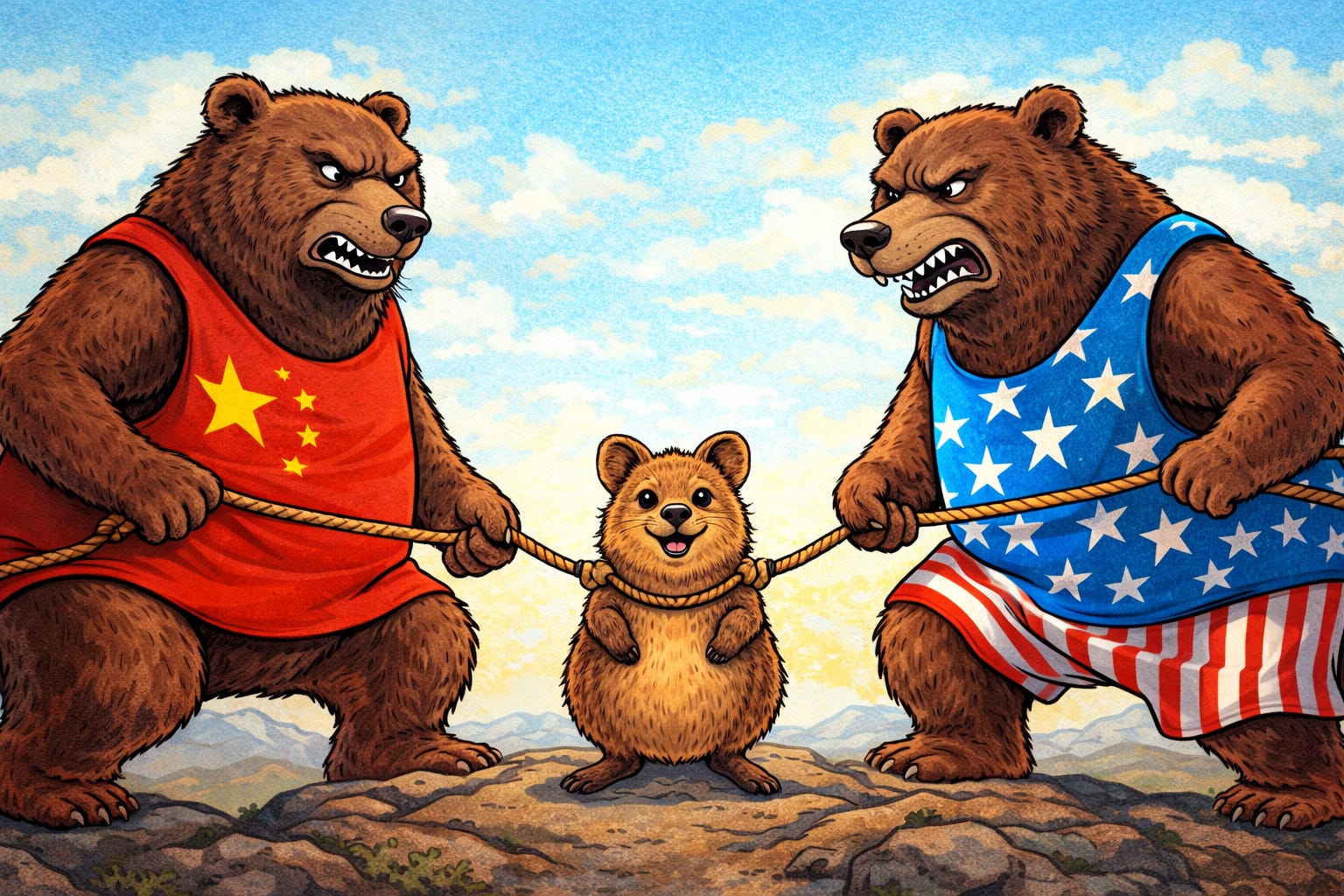
The Albanese government claims to be rising to these new challenges through its economic resilience agenda, aimed at strengthening domestic capability and diversifying supply chains. Critics, however, argue that these appeals to resilience are strategically shallow and are being used to justify net zero industries that remain heavily dependent on Chinese production. On our current trajectory, we continue last century’s pattern of relying on American power for security while deepening our dependence on its primary rival. I’m struck by a vision of a quokka tethered to two bears as they snort and pace.
From within the Coalition, Andrew Hastie has begun to signal a desire to break with the long twentieth century. He claims that “the post-Cold War global order is now dead” and that “Australia is unprepared to meet that harsh new reality”, a degree of stark realism most other politicians here refuse to adopt. He argues that Australia is now facing a political rupture with a decades-long “uniparty” made up of both centre-left and centre-right leadership. In his view, the Liberal and Labor parties have been tacitly united by an “unconstrained” political vision that has led the country down a destructive path of mass migration, debt accumulation, and the hollowing out of Australian industry and institutions.
I’d argue that Hastie’s “uniparty” is our Antipodean mirror of the American regime against which Trumpism emerged as a populist revolt. After the Cold War, America sent much of its productive capacity offshore as it retooled into a predominantly service-based economy, and we followed suit. In both countries, the political left gradually shifted away from its industrial working-class roots and toward a credentialed service class with more cosmopolitan cultural sensibilities. Labor remains tied to unions, but union strength is now concentrated in education, public administration, and health care. Much of its organised base is now embedded in institutional sectors whose fortunes rise and fall with public spending.
Meanwhile, the Australian right became symbolically conservative, ceding the social terrain to Labor and the cultural sensibilities of its institutional base while liberalising the economy in ways that increasingly benefited asset holders and global capital. The result is a mixed bag of Australians whose interests, values, and political power have been pushed aside by big business and big institutions.
Commentators here like to dismiss Australian expressions of culture war as nothing more than social media pathology, but the conflict isn’t that abstract. It reflects the class logic of the American-inspired global model we imported, and the fact these political leftovers can now network on social media. With local variations, this basic political pattern plays out across the deindustrialised West, where populist uprisings are contesting the reigning political paradigm, or in Andrew Hastie’s terms, the “uniparty”.
Hastie isn’t a populist, but he recognises that our existing political economy “no longer supports the aspirations of mainstream Australians” and calls for a “massive overhaul”. Whether these ambitions can be expressed through the arthritic bones of the Liberal Party remains to be seen. The prevailing mood, to which the polls attest, is that the Liberals seem unable to manoeuvre even basic reforms, let alone deliver an overhaul. In frustration, political energy moves further right, toward One Nation, which takes a brash, quasi-Trumpian approach to demolishing the old order.
Horne’s critique of 1960s Australia was that we were led by uninspired figures formed in the imperial British mould of the previous century. Since the turn of this century, our leaders have reprised the same type. Only now it’s the imperial American caste that shaped them. Under their leadership, we’re coasting toward a nation with all the charm of an international airport, where everyone is from somewhere else, consumer commerce pervades everything, and the rich seclude themselves in private luxury.
Though Australia has changed a lot, I still see glimmers of the country Horne described in my day-to-day life. It remains largely uninterested in politics, even as structural conditions make the pursuit of innocent happiness difficult. For the most part, it lives offline and on the periphery of our cultural representations, in the practical competence of people simply getting on with it.
It’s rhetorical sleight of hand to blame a nation’s pathologies on foreign influence alone, and that’s not my argument. Horne himself noted that Australians and Americans mean much the same thing when we speak of freedom, equality, affluence, and the pursuit of happiness, in a way we never quite did with the British. We share much of America’s civilisational DNA, and we’ve been influenced by the great nation lke a young boy is influenced by an admired older brother.
But under Donald Trump, and perhaps in honest recognition of its material decline, the United States is pulling back from the big brother role. And as that shelter thins, we have to confront some difficult questions. Who are we? What can we make here? What can we defend? What is our distinct way of life, and how do we conserve it?
If we continue to avoid these hard questions, I fear who we’ll imitate next.
Michael Nayna is a filmmaker and managing director of Checkpoint Media.

As Horne wrote 'a first rate country run by second rate people'. Enjoyed your piece (if enjoyed is the word). Vision and conviction is MIA in Australian politics (self-interest rules) and change is upon us at such a rapid rate that I fear we're about to become seriously unstuck or as my mum used to say 'tears before bedtime'. A good article which resonates all too loudly for comfort.
"I fear who we’ll imitate next" - alas if the COVID response was any indication, it'll be Communist China. In our shift to cosmopolitanism we seem to have lost a lot of our larrakinism and healthy disrespect for authority - here's hoping the newer generation can find it again. Thanks for a great article Michael.