


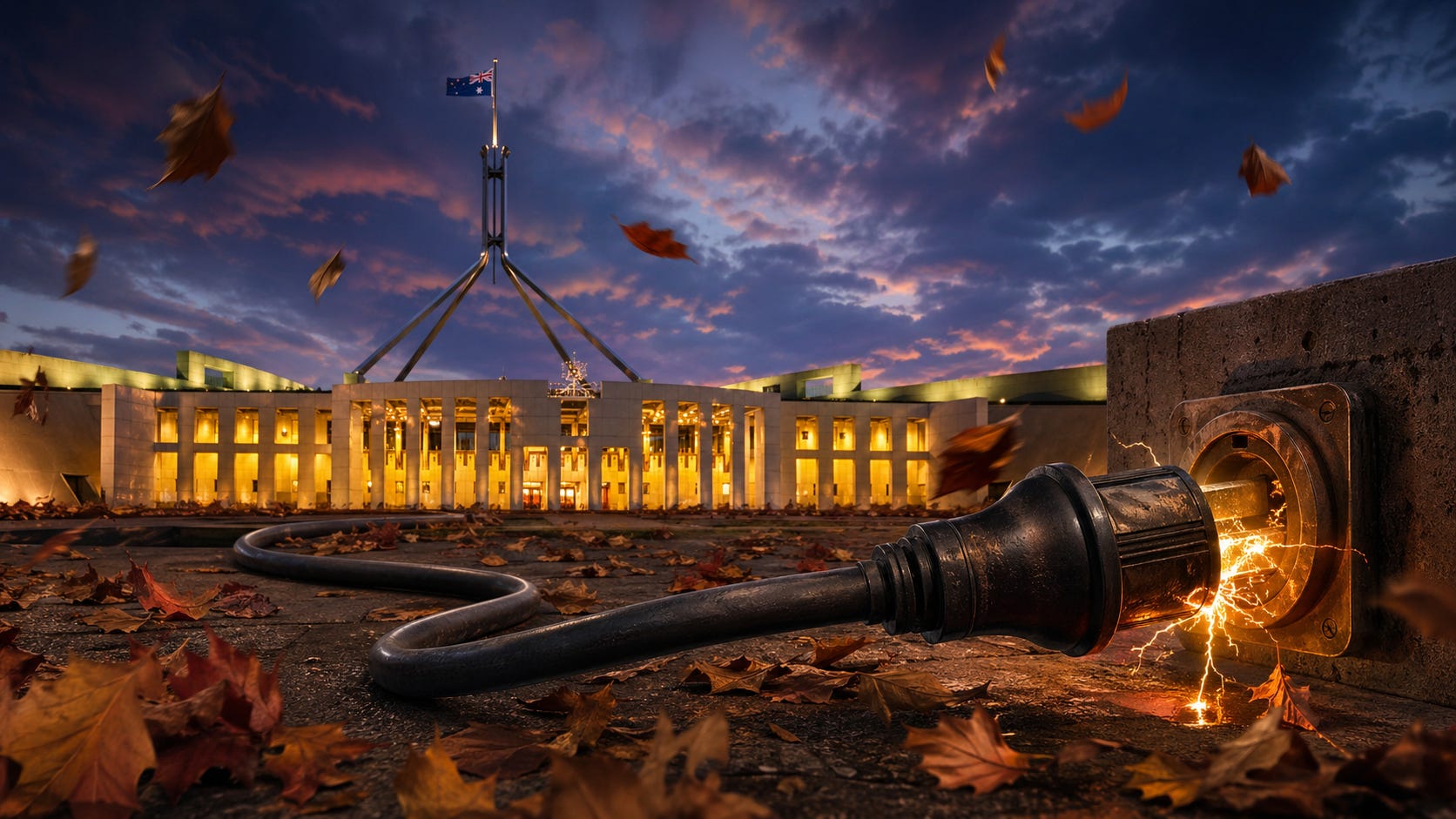
The leaves are turning in Canberra and the lights are burning late in the Treasury.
’Tis the season when budgets are conjured, part accounting, part alchemy, all a creature of the ruling regime. No budget is a dispassionate record of taxes being minted into services. It isn’t exactly all lies and jest either, more a pocket full of promises pledged and hedged, of dreams floated and burst. And, alas, the intentions are too often better than the ideas.
Every budget is a political manifesto. Part of the Treasurer’s job is to craft the lines that make it look as if your money is being spent wisely and, nowadays, to make $1 trillion worth of gross federal debt defensible. Budgets are a weapon designed to be wielded in the daily cosplay combat of politics.
But this year is different. The real world is intruding on budget abstractions, forcing a messy rewrite of long-held assumptions. A fuel shock has underscored something that Treasury boffins and almost all economists usually ignore: without energy nothing works.
What is money if not a claim on future work? Energy is the capacity to do that work. Power is the rate at which that work is done. Money is a pledge of energy that unleashes the power that creates our wealth. To this add materials and technology. You can’t build without materials, and great minds drive innovation and progress.
But all of it rests on energy. Money makes promises; energy keeps them. Unplug the machine and it dies.
Budgets talk constantly about energy policy but barely ever about its role as the physical foundation of the economy. Governments can borrow to fund a promise. The Reserve Bank can create money. But neither can create the energy or the materials needed to cash the hope cheque. When money runs too far ahead of the material world, the gap is closed by inflation, slower growth, scarcity and the call on future work we call debt.
Perhaps the only virtue of the current liquid fuel crisis is in forcing a rethink. The subtext of this budget is a government being confronted by the realisation that it lives in a material world. It has hit pause on the demonisation of fossil fuel because running out of diesel, jet fuel and petrol would lead to economic collapse. Even a significant shortage would be catastrophic. Turns out coal, oil and gas still account for 91 per cent of all the energy that runs this country each year, despite the endless procession of headlines proclaiming an energy transition. No government can ignore this.
This column’s only iron law of politics is: deeds matter more than words. Hard on its heels comes the rule of human affairs coined by Labor giant Jack Lang: in the race of life, always back self-interest, because you know it will be the only horse trying.
In Anthony Albanese’s race around the region trying to shore up liquid fuel supplies, he is bartering with Australia’s record as a reliable supplier of liquefied natural gas and, sotto voce, coal. Albanese understands his government’s existence depends on keeping the supply of diesel, jet fuel and petrol flowing, and knows the only cash in this trade is hydrocarbons. This tells you he has ordered his priorities around the immutable rules of politics.
There is, on cue, the cry that wind and solar will pave the way to energy independence. Sure, it will have its place. But the government is also exploring another refinery, which will not run on sunshine or the breeze. A refinery needs oil, and it makes no sense in the wake of this crisis to get that oil anywhere else but here. There is talk of more fuel storage. Yes, the winds of change are blowing, but watch the weathercock for direction.
Hopefully another realisation will slowly dawn on cabinet. It is materially impossible for wind, solar and batteries to replace everything that fossil fuels do.
It is also impossible to rapidly cut fossil fuel from the energy system that coal, oil and gas built and run.
The modern world was constructed on a moment in human history that is unique, revolutionary and unrepeatable: when the extraordinary properties of oil were discovered and harnessed. The industrial revolution began when we moved from burning wood to coal, to boil water and make the steam that turned the wheels of progress. Oil supercharged growth because it is liquid, light, portable, storable and remarkably energy dense. There is nothing else like it.
And what happened? The world became richer, faster than at any time in human history, because hydrocarbons added an invisible army of workers to our ranks. Since 1900, as hydrocarbons flooded the energy system and oil became the master fuel of modernity, world output has soared by about thirtyfold in current-dollar terms.
It transformed subsistence into surplus, short lives into long ones, and changed a world defined by limits into one that appeared, for a time, to escape them. With these fuels humanity pushed its boundaries into the skies and towards the stars.
We still measure oil in barrels, a relic of the industry’s earliest days when crude was stored and shipped in wooden casks. A single barrel of oil, of 42 gallons, about 159 litres, is equivalent to many years of human labour and the world consumes about 100 million barrels a day.
Nate Hagens, founder of the Institute for the Study of Energy and Our Future, calculates that when you combine that with coal and gas, the world uses about 100 billion barrels of oil equivalent a year, each embedded with five years of human labour.
“That’s 500 billion human labour equivalents working alongside about five billion actual human workers,” he said on his podcast. “One hundred fossil ghost workers for every living one. Every economic miracle of the last 150 years was underwritten by this invisible workforce.”
We built the machinery of our civilisation on the abundant, reliable and cheap availability of the energy trinity of coal, oil and gas. The foundations run all the way down to the molecular level of the hydrocarbons embedded in everything we use, from the polymers in plastics to the ammonia that makes synthetic fertiliser. Building up, we created vast cities, sprawling suburbs, industrial agriculture, global supply chains and mass mobility.
Now, with the closure of the Strait of Hormuz, we are offered a glimpse of how the machine really works, and where our prosperity comes from. Choke point is more apt than most realise because if you squeeze the flow of hydrocarbons, the global economy begins to gasp for breath, because energy is our atmosphere. To borrow from Hagen, most people swim in fossil energy like a fish swims in the sea and they are blind to it.
But the dependence is deeper and the danger greater than many realise because of the link between energy and economics.
This cut in supply exposes how fragile every single system we have built is. The machine we built is the foundation for the financial and political systems that govern the world. Break the base and everything falls. The longer this crisis endures the closer we come to a tectonic shift.
The world will change in dangerous and unforeseeable ways.
Energy surrounds us. It sustains us. Your lifestyle depends on it. Without it, societies suffocate. We almost never think about it. Until it is gone. And when it is gone, all the promises in the world mean nothing.
This article was first published in The Australian.
I am having this sort of conversation a lot now. Friends and family glaze over and argue, saying things like, "yes, but...", or "what about carbon", the "planet", "greedy industrialists", or the ultimate, "I've bought an EV", as if that makes everything alright now. Reading the eco-drivel from the Gaurdian is depressing enough but the comments underneath are enough to make you give up on humanity - they just refuse to get it.
I wonder where the art gallery 'Just Stop Oil' vandals are these days... probably planning on their iPhone made from hydrocarbons.
Die-hard socialists (communists?) to their core, Labor governments are not that fussed about those who work for themselves (SMEs) nor the private sector because their Utopian vision is an Australia of public servants. Trouble is, they haven't joined the dots: how is their army of supporters going to cope without their computers, printers, chairs, desks, trains, buses, cars, scooters, coffee machines, refrigerators, and the electricity to power all this stuff? The simplicity of logic is lost on Bowen, Albo and the rest of the numpties, including the virtue-signalling Teals and their evil sister, the Greens. Without hydrocarbons to feed us, fuel us, defend us, heal us, shelter us, we die... slowly but surely. How is it possible that so many Australians believe in fairies at the bottom of the garden, in mythologies and ideologies over scientific facts?