


Ever since I started in film and television in 1999 as a young video editor in Sydney, there has been a camera race.
I love technology. I love new gear. I always have, but I feel as an industry we put too much emphasis on technology. Since I was a kid, I loved cameras. Filming is just part of who I am. I was filming my dads footy games at 6 years old.
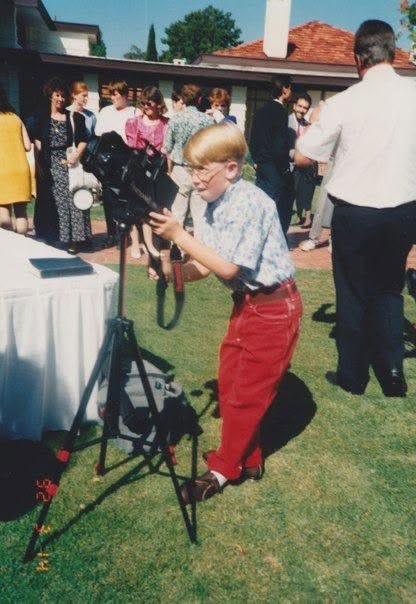
First, it was SP Betacam for television and 35mm for theatrical films. That was the standard. Then it went digital. We had Digital Betacam and then HDCAM for television and theatrical production.'
Every new camera brings improved image quality. Improved workflows. And, above all, it usually brings the costs down.
Back in the day, a Digital Betacam camera would have cost around $90,000. That’s a huge expense for a camera in today’s world.
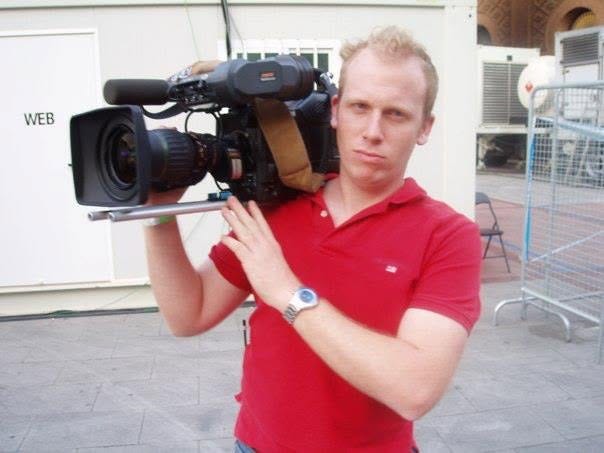
For viewers at home, they have been the ultimate beneficiaries of the camera race. Improved viewing experiences. Greater immersion. Better pictures.
The TV manufacturers have also enjoyed a consistent flow of resolution upgrades over the years. We had high definition, then 4K, and now we’re up to 12K. Every new resolution brings a new model of TV that consumers are encouraged to shell out for.
Fast forward to the last decade and there are now so many cameras on the market, all at relatively low price points. From $1,000 up to $15,000, these cameras can shoot incredible pictures that the boy I was in 1999 would have loved to see.
With all the ruckus around camera technology and the latest release, it’s easy to get caught up in the excitement.
However, one thing has never changed.
It’s what you are filming.
It’s the subject matter and the story.
For cinematographers, I feel too much focus has gone into resolution, dynamic range and colour science.
We need to remember what we are doing and our intent.
It is to tell stories.
In that way, if you have a good or great story, almost any camera will do.
More energy should be applied to understanding storytelling, emotions, how lighting affects emotion, composition, movement and the way an image makes someone feel.
These things should be celebrated more.
Camera vendors have got us all sussed. They release a camera, get us all hot and bothered about the latest technology, and meanwhile we have forgotten the storytelling aspect.
Yes, of course, cinematography is a perfect combination of right- and left-brain thinking. It always will be.
It is the perfect pursuit of creativity and technical know-how, brought together in one stream of decision-making.
Cinematography is also one of the few callings where you can enter a state of flow unlike almost any other job. And as many cinematographers can attest, that’s one of the most spiritual and cathartic experiences on the planet.
My daughter recently found an old digital camera from 20 years ago on the bottom shelf.
She got a battery from Amazon and got it back up and running.
Recently, my parents’ health has been declining. They are both now living in nursing homes, and it’s been really tough to see their health decline so rapidly. It’s an emotional time for me and the family.
On a recent visit to see my parents, my daughter took some happy snaps of Mum and Dad.
The picture quality is terrible.
It’s blurry and, compared with the latest and greatest cameras, it is a clear failure.
However, it’s the content of the images that made me emotional.
It’s seeing the people. Knowing their stories. Knowing the meaning behind their faces.
That’s what brings the emotion.
The picture quality is terrible.
The emotional quality is through the roof.
The cameras of today are providing scientifically perfect images. And that race isn’t ending any time soon, particularly when there is money to be made.
But perhaps the perfection of the image could actually be a problem for us humans.
So much so that there is now a trend in cinematography to deliberately bring noise, interference and aberrations back into images.
Using filters that degrade the image. Using old lenses. Bringing back imperfections. Perhaps we’ve reached the point where technology has become so good that we’re deliberately making it worse to make it feel better. Just like my daughter and the old camera, it is the imperfection that communicates humanity.
Indeed, Christopher Nolan’s The Odyssey was shot on film.
He brought back an old format: film.
And God, doesn’t the world just love it.
Christopher Nolan has, in some ways, helped remind us of the magic of an old, faithful format.

But perhaps it isn’t really the film that we love.
Perhaps it is the love story. The epic story being told. The characters. The emotion.
Perhaps that is what we are really looking for as humans.
I would argue that the IMAX element of the film is, to some degree, marketing hype. If Nolan had decided to shoot it in 35mm or digitally, I suspect it still would have been a hugely successful global film.
But the IMAX story adds another layer. Another reason to go to the cinema. Another reason to spend money on the experience. The IMAX camera is a means for Nolan to tell the story. It is not the story in itself.
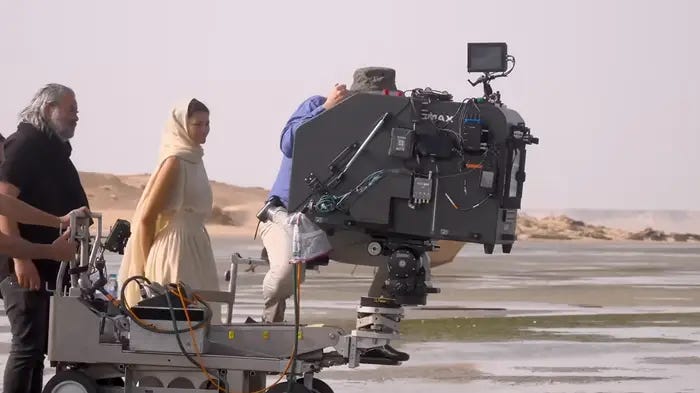
The wild thing about the Oddesy was that many of the shots were deliberately allowed to be imperfect, including being out of focus, but no one seems to care, not even Nolan. As it’s the performance on screen that conveys the emotion well enough to overstep the technical imperfections.
Perhaps what we need is to remember that, yes, the tools we have are important. They help us in life and in our jobs as filmmakers and shooters.
But in the end, it is the emotion of the story that we must not remove ourselves from.
We need to educate ourselves not only about dynamic range charts, resolution, codecs and colour science, but also about story arcs, plot lines, conflict, character and the essence of storytelling.
In equal measure.
Because, in the end, this is why we do what we do.
We are here to tell stories.
To bring people into a state of emotional response. To make them feel something. Let the camera vendors fight it out to get our attention. Let them keep pushing the technology. We should embrace it. Use it. Enjoy it. But let’s put our focus on the story. Because that’s where the real flow state is.
It always has been.
This also has relevance to why vinyl records have made a resurgence - I feel that people are getting tired of the "perfection" of digital and how the analogue aspect and imperfections inherent with vinyl actually enhances the music experience.
Great article Michael. You have hit the nail on the head. In my field of still photography cameras have advanced to incredible levels of dynamic range and image quality. This does not mean the images will be any better than old film shots that told a story and conveyed emotion. I sometimes crave for the old times of film which forced us to slow down and craft a story through a single image.