

By Michael Newman
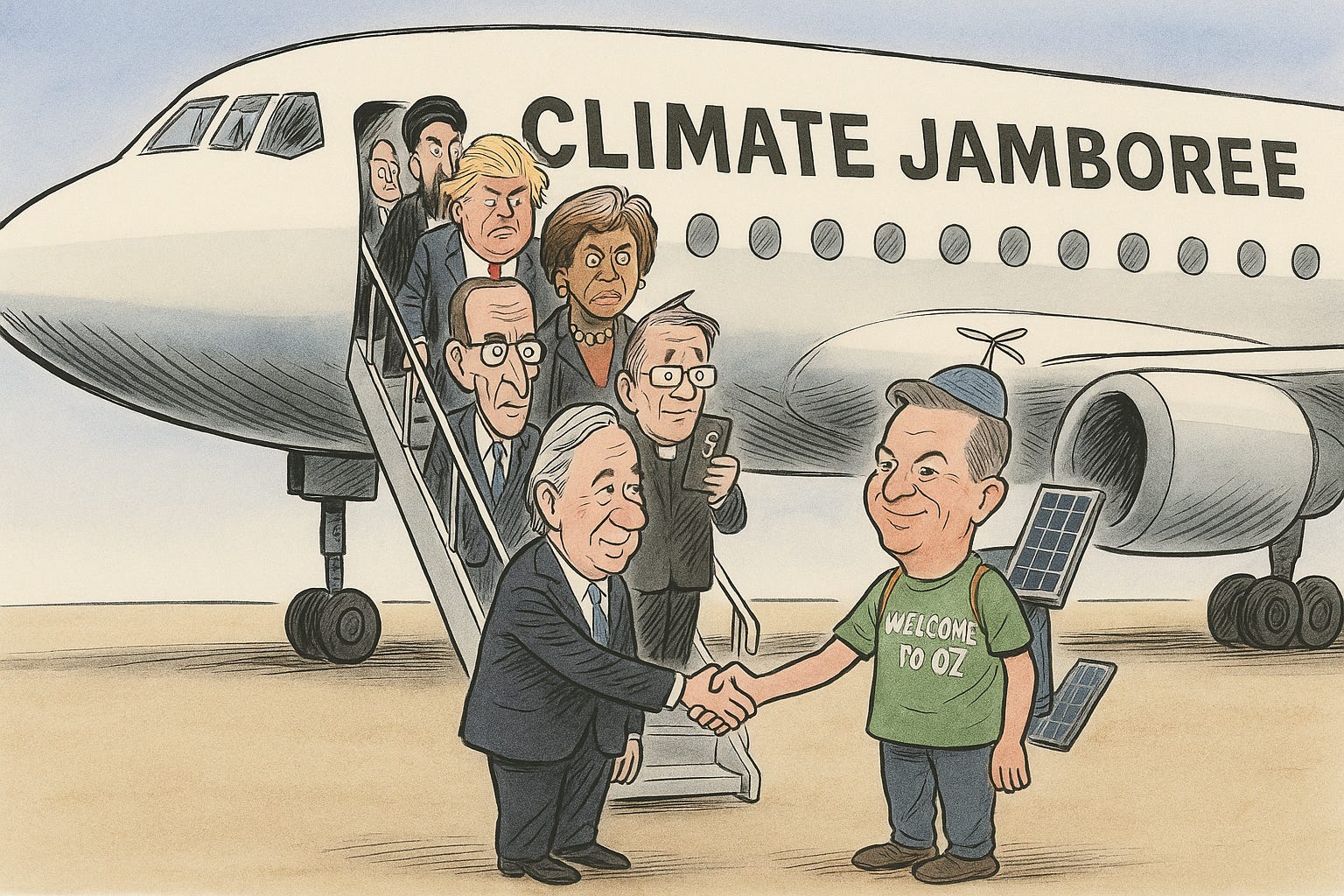
When it comes to quantifiable waste and hypocrisy, the yearly Conference of the Parties (COP) climate summits run neck and neck with the private jet set at Davos. Either way, both groups sanctimoniously feel duty-bound to lecture parents—who drop their kids off at soccer practice in second-hand hatchbacks—on the dangers of climate change and demand they rethink their selfish behaviour. Every single year, rent seekers kneel at the altar of the pagan climate gods, looking to be bestowed with never-ending taxpayer blessings.
For the United Nations Intergovernmental Panel on Climate Change (IPCC), without COP, it loses what little relevance it has—and with it, funding. It wants countries to bid for COP in much the same way they do for the IOC or FIFA to win the rights to host the Olympics or the World Cup. Sadly, watching groupthink politicians and bureaucrats regurgitate the same disproven, hysterical talking points is hardly the same as watching the 4x100m relay final. That’s why COP hosts appoint official broadcasters—there’s no commercial value in bidding for it.
Which begs the question: why is Australia pushing so hard to get COP31? In the thirty-odd previous COPs, what has actually been achieved? The zealots will argue that commitments and accords are signs of progress. Watch the hips, not the lips.
It is an inconvenient truth that 90 per cent of countries missed the February 2025 deadline to submit updated Nationally Determined Contributions (NDCs) as required by the Paris Agreement. Oh well.
For the conservative $200–300 million of our money that will theoretically be spent on COP31 if we are selected, the private security, tourism and hospitality sectors will likely be the only beneficiaries. There have been—and will be—no lessons learned, because anything that runs counter to the narrative of climate alarmism prevents collectivists from self-appraising their genius and justifying further requests to waste our dime on future talkfests.
However, the doomsayers have an odd way of displaying personal commitment to warding off the threat of rising temperatures.
In 1995, COP1 in Berlin was attended by 2,044 participants. The 2009 COP15 summit in Copenhagen ballooned to 27,000. The 2015 COP21 summit in Paris breached 30,000. After COVID-19, the 2023 COP28 summit in Dubai smashed all records with 83,000 participants, with another 2,000 online. To put it in context, the equivalent of more than 530 full Boeing 787 flights would have been required to ferry these delegates to and from the conference.
Has there been any appreciable progress in saving the planet by having forty times the number of attendees, irrespective of the explosion in emissions to transport, house and feed them? Facts don’t care about feelings.
In 1995, global GHG emissions totalled 32 gigatonnes. Today we sit at a record 48 Gt. China’s share of global emissions has grown from 12 per cent to 31 per cent. Never mind that 97 per cent of CO₂ is naturally occurring. Yet somehow bureaucrats believe we can control the weather by legislating the three per cent caused by man-made sources—much less Australia’s 1.3 per cent of that. At 430 parts per million, Australia’s contribution to CO₂ as a share of the atmosphere is 0.0000167 per cent. If we went to zero tomorrow, it would not make a ripple. Yet governments and think tanks believe a carbon tax or emissions trading scheme is the fix.
The number of coal-fired power stations built over the same period has increased by 50 per cent, with boilerplate capacity more than doubling to 2.2 terawatts of power. New proposals to build coal-fired power plants in 2024 alone totalled 116 gigawatts of capacity—92 per cent of that in China and India. Coal consumption has ballooned from 5 billion tonnes to over 8 billion tonnes today. China consumed 56 per cent of that in 2024 and six years ago completed the 1,814-kilometre Haoji rail line dedicated to transporting coal to the inland regions. Hardly the sort of infrastructure one builds as a commitment to reducing emissions.
Global oil consumption has increased from 69.1 million barrels per day thirty years ago to 104 million bpd today—a new record. Annual global natural gas demand has doubled since 1995 to another high of 4.13 trillion cubic metres.
Yet for all the noise we hear about China’s aggressive roll-out of renewables—which masks overproduction by a factor of more than two—barely does the coal-fired power used in the production process, much less Uyghur slave labour, rate a mention. As former President Joe Biden famously suggested, China practices democracy differently.
Despite these inconvenient truths, governments continue to peddle the idea that without drastic action now, we are doomed unless we rapidly transition to part-time power with backup battery storage.
Australia’s commitment to following the path of Germany—the globe’s crash-test dummy for an all-renewables grid—is concerning. German energy prices are 40 per cent higher than the EU average. Thirty years ago, manufacturing was a quarter of GDP. It is now less than 18 per cent as businesses, including Volkswagen, have been forced to close factories due to uncompetitive energy. In 2024, the German Federal Environmental Agency (UBA) estimated that 10 per cent of the 30 million households in Germany were in energy poverty.
Is it any surprise that 1,400 manufacturers in Australia became insolvent in 2022–23, at triple the rate of the prior two years? Is it any wonder that one in seven Australian households identify as energy poor amid rising energy costs? Somehow it seems we’re behind Germany in its energy transition—but steaming ahead in relative failure.
Why is it that this year alone, Belgium, Denmark, Spain, Taiwan, Italy and Sweden have reversed their stance on phasing out nuclear, in order to reliably reduce emissions without killing their economic bases? If Minister Chris Bowen is confident that nuclear is the most expensive form of energy, he should be the first to support lifting the moratorium—to prove his superior insights as the private sector refuses to die on that hill.
Since President Trump won the 2024 election, why have so many megabanks exited the Net Zero Banking Alliance (NZBA)? HSBC, Bank of America, Goldman Sachs, JPMorgan, Macquarie, Sumitomo Mitsui, Mizuho, and Mitsubishi UFJ—to name a few. Clearly, their hearts were never in it. It was a self-serving decoy designed by marketing departments to avoid negative headlines. Follow the money.
Interestingly, exchange-traded funds (ETFs) in renewables sectors have chronically underperformed over the past five years. Nuclear and fossil fuel ETFs have been star performers over the same period. So despite the marketing hype, financial markets walked a different talk.
Perhaps media companies should read Donna LaFramboise’s The Delinquent Teenager to understand what investigative journalism looks like—and why misallocated taxpayer funds will bankrupt our nation:
“In early 2010 the InterAcademy Council, an organisation comprised of science bodies from around the world, took an historic step. It established a committee whose purpose was to investigate IPCC policies and procedures… The committee posted a questionnaire… the collected answers totalled 678 pages.
“There are far too many politically correct appointments, so that developing country scientists are appointed who have insufficient scientific competence to do anything useful. This is reasonable if it is regarded as a learning experience, but in my chapter… we had half of the [lead authors] who were not competent.” (p. 138)
Lest anyone think people from less affluent countries were being unjustly stereotyped, the person whose comments appear on page 330 agrees:
“The team members from the developing countries (including myself) were made to feel welcome and accepted as part of the team. In reality we were out of our intellectual depth as meaningful contributors to the process.”
It is unlikely much has changed over the past three decades. Low-resolution thinking is a hallmark of global governments, which will use COP31 as a photo opportunity to regulate further and justify sinking even more taxpayer money into vanity projects to cover up the fundamentally flawed strategic thinking that underwrites it. Don’t be surprised if Treasurer Jim Chalmers eventually introduces a tax on unrealised capital losses to pay for the profligacy.
Climate change alarm is all about money and power but pitched as environmental salvation. We need call out which professions and investors stand to gain at the public expense
Necessary, concise commentary. Thank you