


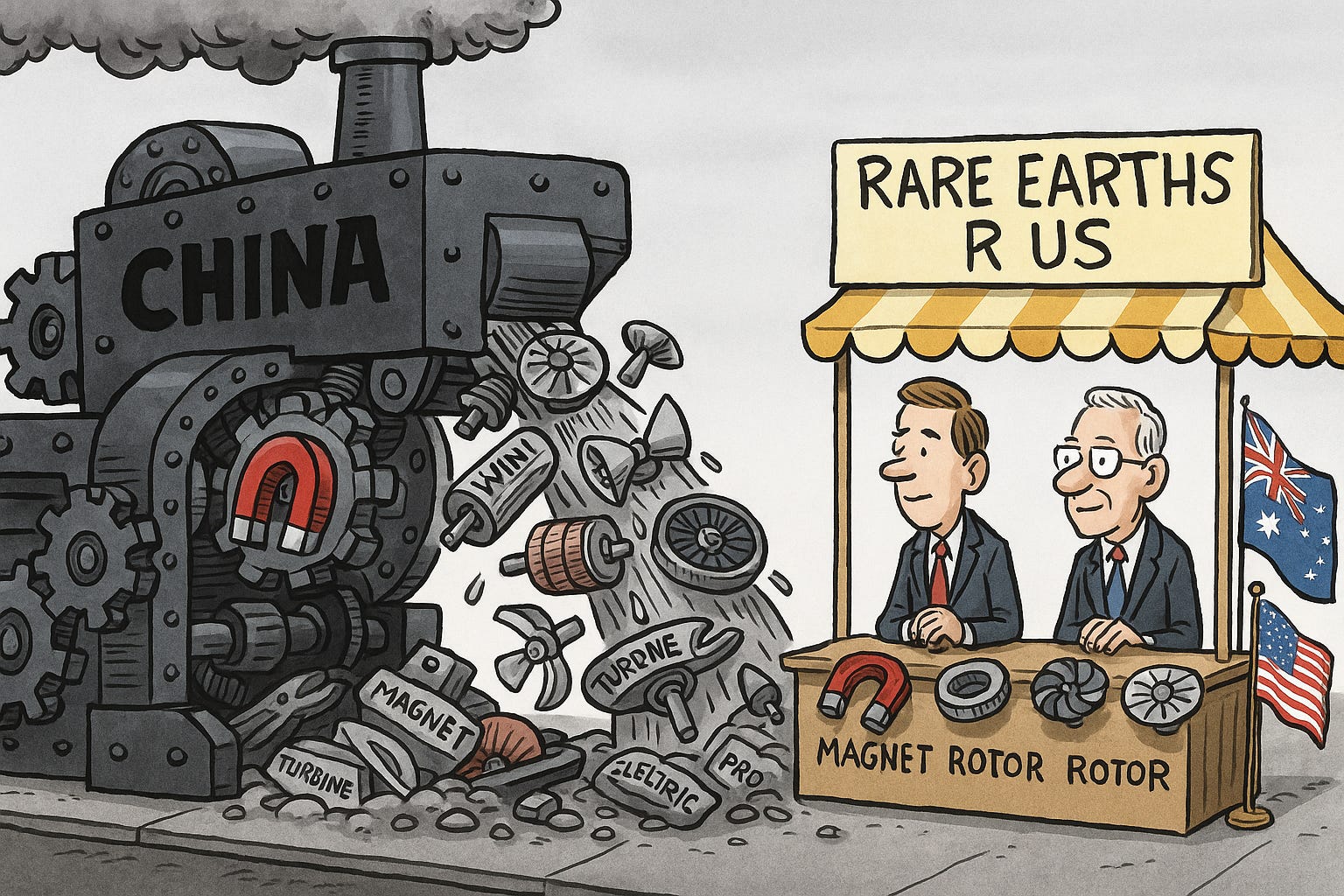
Buried in the fuselage of every one of Australia’s US-built joint strike fighters is about 420kg of rare earth materials, much of it in the shape of powerful permanent magnets. Every nuclear-powered Virginia-class submarine has about 10 times that weight of the elements encased behind its hull.
To put the word powerful in perspective, a neodymium-iron-boron magnet is roughly 1000 times stronger than the ceramic one holding your shopping list to the fridge. A piece the size of a matchbox can lift around 100kg of steel.
Inside the fighter these rare earth magnets have several jobs: spinning something, holding something steady or sensing what is happening, all part of the invisible choreography that lets America’s most advanced aircraft fly, see and fight.
In an irony so profound words fail, almost every gram of those rare earth magnets has passed, at some stage of its manufacture, through a refinery in China.
Beijing controls about 60 per cent of global rare earth mining and more than 90 per cent of processing and magnet production. It dominates every step that turns rock into the metals that power fighter jets and propel nuclear submarines. So you don’t have to be a geostrategic expert to see that this wrinkle in the supply chain just may be a problem for the US and its allies.
Three decades ago, paramount leader Deng Xiaoping saw the value of these minerals to his nation. “The Middle East has oil; China has rare earths,” he said.
They are not called rare earths because they are scarce but because they are rarely found in concentrated deposits and are fiendishly hard to separate once mined. Vast quantities of rock must be dug up and crushed to extract a handful of usable minerals.
And that’s the easy part. The real work is in the refinery, where a chemical process dissolves, filters and precipitates the earth through a toxic bath of acids and solvents to tease out each element.
Every stage demands heat, pressure and precision. The ore is roasted, leached with hydrochloric or sulfuric acid, then run through hundreds of solvent-extraction tanks where the elements are separated one molecular layer at a time.
The waste left behind is caustic, often radioactive, and hard to clean up. That’s why most of the world was happy to let China do it.
The process is also astonishingly energy-hungry. Refining rare earths requires sustained high temperatures, hundreds of degrees in the cracking and roasting stages, and constant electrical power to pump and separate chemical solutions. In China, that energy mostly comes from coal-fired plants and natural gas, which is why the country can process rare earths more cheaply than anyone else.
So, in a now routine observation by this column, once you lift the bonnet on just about any part of the “green transition” you find furnaces fired by fossil fuels.
The metal box that sits behind the blades of a wind turbine houses a ring of rare earth magnets that turns rotation into electricity. A large offshore turbine contains tonnes of magnets in its generator. Every electric car carries a few kilograms in its motor, where those magnets spin a rotor that turns electricity into motion.
Relying on the cheapest supply chain for these goods worked in a globalised free-trade world, even though it was strategically stupid in any age.
In a world of increasing geostrategic competition it is deeply dangerous because the Chinese Communist Party sits at the choke point of the modern economy.
In early October, Beijing tested its economic weapons system. In response to a US Commerce Department expansion of export controls on Chinese companies Beijing trumped it with new licensing rules for every stage of the rare earth supply chain. Any company using Chinese-sourced material or technology – from the mine to the magnet – would now need Beijing’s permission to sell abroad. As energy analyst Doomberg put it, this was China’s declaration of “economic nuclear war”.
That rocked the US, and President Donald Trump blustered about imposing 100 per cent tariffs on Chinese goods. This set the stage for Anthony Albanese’s triumphant visit to Washington. The White House needed the optics and the reality of what he was selling, even if the deal is still a long way from displacing China from its dominant role in the world supply of rare earth materials.
Perth USAsia Centre chief executive Gordon Flake hailed the agreement, saying the focus should be on extracting Beijing from processing in the defence supply chain, which is a small part of global demand.
“Our objective here is not to try to remove rare earth processing outside of China, not even to fully compete with China, but to ensure that a sufficient percentage of rare earth processing is done external to China, to guarantee supply for our defence, national security, defence industry and advanced communication needs,” Flake said.
“And also to deny China monopoly behaviour so that it doesn’t disrupt our needs in an era of geostrategic competition. That’s a much more manageable goal.”
It also made sense to spread the load across the broad alliance of like-minded nations.
“Right now, there’s a lot of places that do the initial phase, the mining, the extractions of initial cracking, leaching,” Flake says. “There’s a lot of countries that do the final metallisation, like Japan and South Korea. But there’s not a lot of places that do that midstream processing and that’s where the choke point is, because that’s almost entirely in China.”
There is no getting around the fact we will have to pay a premium for rare earths that bypass China.
“We don’t have the economies of scale that are sufficient for us to compete with China on a dollar-for-dollar basis,” Flake says. “So we need to understand that for national security purposes it’ll be more expensive than commercially available rare earth elements.”
The Prime Minister and Australia’s US ambassador Kevin Rudd deserve the credit they are getting for the success of the visit and for delivering something that could be consequential to the economy and national security.
But several people told this column the rare earths deal was driven by Resources Minister Madeleine King. She has been pivotal in developing the idea, which began to take shape more than two years ago at a meeting held at the Australian embassy in Washington.
Flake points out there is a long way to go and, for all the talk of environmental concerns, one big question looms over ramping up rare earths processing here.
“To build these facilities in Australia, where we are a very high cost of energy jurisdiction, is going to immediately beg the question, where does the energy come from?” Flake says.
Energy security is national security. That is something King also understands. She may need to hold remedial lessons for some other members of cabinet.
Thanks Chris … for another excellent and timely essay. Other than the diabolical energy situation there is also the sanctimonious over-regulation problem with regard to the environment and indigenous taboos - which are mostly resolved with the enterprise doing the work, going broke! Compare this to China’s numero uno environmental benchmark, ‘a pipe to the nearest river,’ as Doomberg so succinctly put it.
Surely, there’s a pathway in between… if only we had some serious leadership on either side.
PS. I’m happy to chip in for a Doomberg subscription for Chris Bowen & Dan Tehan.
In a world of increasing geostrategic competition it is deeply dangerous because the Chinese Communist Party sits at the choke point of the modern economy.
Ah yes Mr Uhlmann... none so blind as those who will not see nor deaf as those who will not hear eh? Another great essay on Western stupidity (or is it greed that has allowed us, like a snake to the charmer's melodic tune, to be mesmerised into thinking buying cheaper from China or doing deals to bring vast consumer dollars to our lobsters and wine is smart?).
Either or both? It doesn't matter as the outcome is the same. We are economic hostages to China. I wrote a comment in the Australian last week the China does not have to fire a single bullet to wage war via economics on the world. Next time perhaps the sensors won't reject my comments as they may realise the obvious correctness. Between you and another request contributor Mike Newman we are getting terrific information and insights. What a pity Labor-Lite-Ley isn't paying attention to Powerlines where great policy platforms abound. Thank you for your efforts... keep writing.