


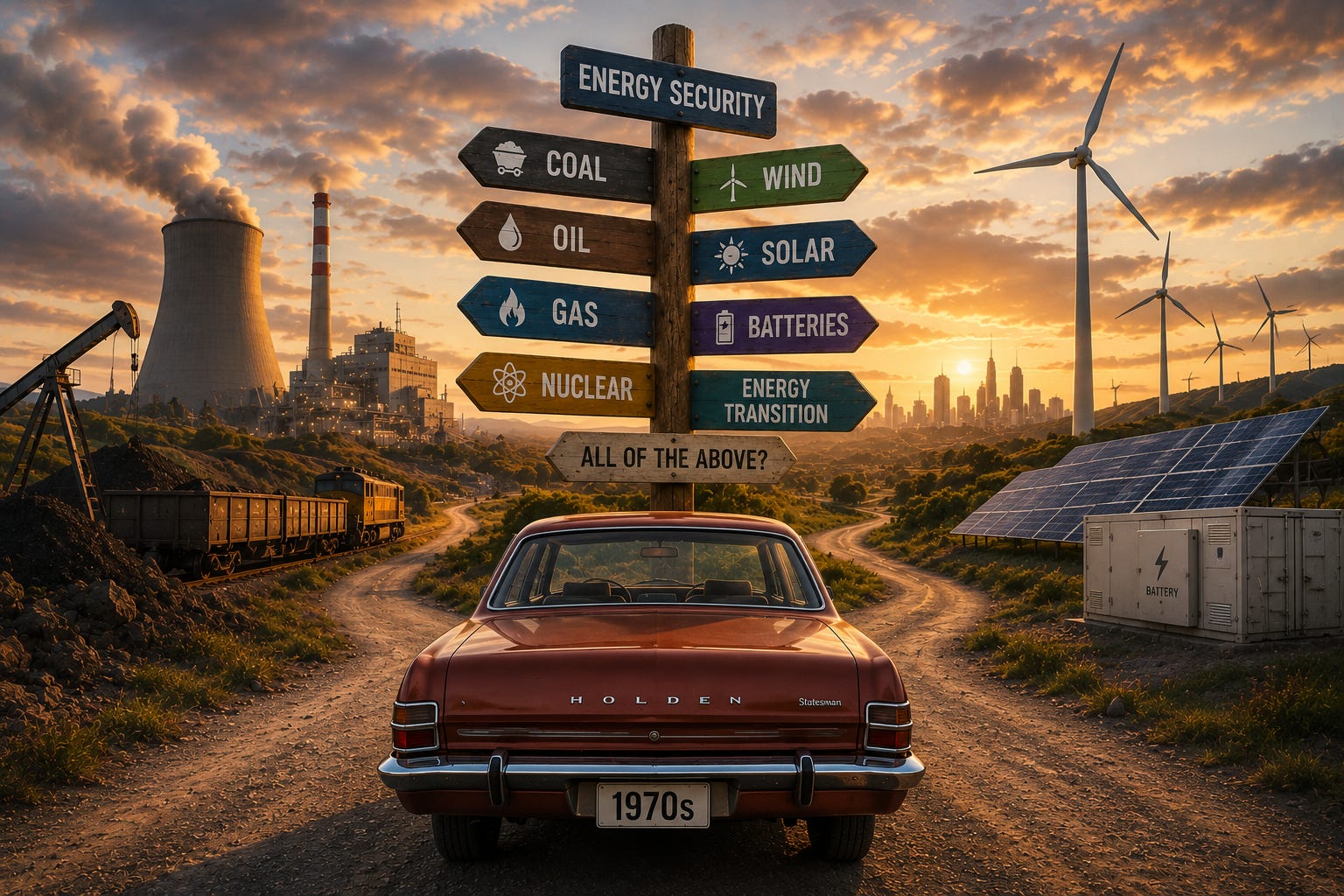
As my mates and I finally got our licences towards the end of the 1970s there seemed to be an unwritten rule for all teenagers: you could drive Mum’s car but not Dad’s.
In the shadow of the 1973 oil shock, the mums’ cars had one thing in common: They were tiny. Because getting a licence is such a seminal moment in any teenage life, the brands are seared into my memory: the Datsun 120Y, the Toyota Corollas and my mum’s car, the Holden Gemini.
But all the dads’ cars were still big and, in those days, most fell into one of two tribes: Holden or Ford. This disposition was genetic and every year sons and fathers geared up for the annual title fight between the rival camps that played out on the racetrack at Bathurst.
My dad was a Holden man and I got to drive the Statesman just once. When I arrived, beaming with pride, to pick up my mate Damien from his place, his father shook his head and said my dad must have rocks in his head. I think that was because Damien’s dad was a Ford man.
Markets and people did change their behaviour after the first big oil shock, but they also hedged. Small cars became fashionable, but big cars did not disappear. People adapted around their needs.
It was during this era that oil’s share of the world’s primary energy system peaked. It has drifted lower since, but the surface story is deceptive because the total volume of oil consumed kept rising as the world grew richer and industrialisation spread.
In 2024 humanity burned more coal, oil and gas than in any single year in history, despite all the talk of record growth in renewable energy. Both statements are true and together they point to a deeper reality. There is no simple transition from one energy system to another. There is an energy addition. New energy sources do not necessarily replace old ones. More often they are layered on top as societies consume ever more power.
The pattern was identified in the 19th century by English economist William Stanley Jevons in what became known as the Jevons Paradox. He observed that as steam engines became more efficient, Britain did not burn less coal. It burned far more. Efficiency lowered costs, expanded capability and unleashed greater consumption. That pattern has repeated ever since.
More efficient little cars did not consign the big ones to history. More efficient computers increased electricity use. LED lighting cut the cost of illumination and we responded by festooning the world with pretty lights.
Human beings rarely use efficiency to consume less energy. More often we use it to do more.
This energy shock will drive a move away from oil dependence and ensure every government tries to secure more of it within their own borders.
There has been a spike in electric vehicle sales here, which is a good thing and will probably endure. But how many of those sales are for a second car?
The geography of our island continent, the way our systems are built and the slow turnover in our car fleet mean it will be a very long time before EVs dominate the private vehicle market. The next step, electrifying all road transport, mining and agriculture, remains a distant dream.
The other feature of this crisis is to highlight what might be called the hangman’s noose theory of politics: the imminent threat of execution does tend to clarify the mind and prompt deathbed conversions. Our leaders have finally recognised that this nation runs on liquid fuel, that energy security is national security and that their job security depends on securing hydrocarbons.
It is too early to declare that the era of fossil fuel hysteria in our leadership caste is over, but it may have peaked. The man who once declared fossil fuels had no place in our future is now on the diesel diplomacy circuit, breathing a sigh of relief each time a supertanker full of fuel heaves into view. The leaders of the march to poverty are quietly retreating.
I have never held Climate Change and Energy Minister Chris Bowen or the Albanese government solely responsible for Australia’s deep exposure to this fuel crisis. That failure has been decades in the making. Several generations of politicians of all hues hollowed out our resilience and the incumbents’ demonisation of hydrocarbons just drove the nails deeper into the coffin.
The measures the government has announced to secure and store more fuel, and the modest proposal to examine expanding refining capacity, are welcome first steps. The aim should be to become as energy self-sufficient as possible and Australia has the resources to do it. That will be expensive and take time, but weigh it against any future crisis.
Gas is on the march from sea to shining sea and even Victoria, whose government turned its crusade against all fossil fuel into a long morality play, has been mugged by reality.
Victoria’s multi-titled Energy Minister, Lily D’Ambrosio, likes to refer to the fuel essential to her state’s survival as “fossil gas”. On her watch Victoria made it all but impossible to tap that resource even as its reserves declined and the state drifted towards energy bankruptcy. Victoria entrenched a permanent ban on fracking and coal-seam gas extraction in its constitution and imposed a moratorium on conventional onshore gas exploration.
When gas prices spiked after Russia’s invasion of Ukraine, in an act of supernatural hypocrisy Victoria whined that it should be entitled to Queensland’s coal-seam gas. It then wanted all Australian taxpayers to underwrite the absurdity of building a liquefied natural gas import terminal in a state sitting above untapped gas reserves. Now Victoria is in the middle of an awkward script rewrite.
This week the Allan government approved Amplitude Energy’s Annie project in the offshore Otway Basin that is expected to begin delivering gas by 2028. The Victorian budget also borrowed more money to secure 10 million litres of diesel.
So the winds of change are blowing, they will likely blow in all directions at once and right now we are in the eye of the storm. If the Strait of Hormuz does not return to something approaching normal service soon, this crisis is far from over. Australia has been insulated by its wealth, but money cannot paper over physical supply shortages forever. We have outbid poorer countries for fuel. We cannot see and do not care about their suffering. But in time the pain will work its way up the food chain.
And amid all this, one of the clearest signals about where the energy story may be heading came from an unlikely place: Formula One president Mohammed Ben Sulayem is on a quest to bring back V8 engines by 2031. The former rally driver has been pushing at this door for some time and, after mounting complaints about the sport’s latest hybrid rules, it may be starting to open.
F1 is the world’s most technologically advanced motorsport, a rolling laboratory where elite engineers push the limits of machine performance. For the past 15 years it has pursued ever more sophisticated hybrid technology, turning its cars into astonishingly efficient but increasingly heavy, expensive and complicated energy management systems.
Many drivers and fans loathe the latest cars. Gone is the raw mechanical violence of the old V10s and V8s, the screaming engines driven flat out on instinct and nerve. The new hybrids draw roughly half their power from batteries, making them fast but bloodless and difficult to handle.
Like everything in energy, there are trade-offs.
The problem at the heart of the new 2026 rules is that drivers are forced to constantly harvest energy under braking and carefully manage how their car’s power is used. Drive reports that, on tracks with fewer heavy braking zones, drivers “are required to do what’s known as “superclipping”, which means instead of using the engine to drive the wheels, they use it to charge the battery, running it as a kind of electrical generator”.
Instead of the machine serving the driver, the driver increasingly serves the machine. The car is no longer built simply to be as fast as possible. It must constantly manage its own energy anxieties, diverting power away from performance to sustain the system itself.
Then there is the cost. Before the hybrid era, engine deals reportedly cost teams between $4m and $7m a season. Today’s turbo hybrid power units run to more than $20m, while manufacturers are estimated to have spent more than $1.4bn developing competitive hybrid engines.
F1 has stumbled into the same dilemma confronting much of the wider energy transition. As systems become more complex, more capital, engineering and effort go into managing energy, storing it, shifting it and stabilising it, rather than simply producing abundant, reliable power.
Producing affordable, reliable energy using all our natural resources should be the goal of any sensible government. Without it we will go broke. We should reduce emissions where we can, as fast as we sensibly can, within the limits imposed by physics, engineering and economics, not driven by slogans such as net zero.
As we are learning, physical systems do not bend to ideology.
This article was first published in The Australian.
Excellent article, as I commented earlier when it was in The Australian. However, the discussion is never complete unless the nuclear option is addressed as well. We have abundant uranium reserves, and we have the technical expertise to do it, plus we have arguably the world's most stable geology in northern SA for storage of nuclear waste. We already sell yellowcake to the world; we should also be using it ourselves, to provide long-term stable baseload power.
Thanks. Always enjoy the personal memories preceding the analysis. There seems to be a real problem in this debate because there is no debate. The next COP should be interesting in terms of the impact of economic hard times and how much cognitive dissonance is revealed. .