


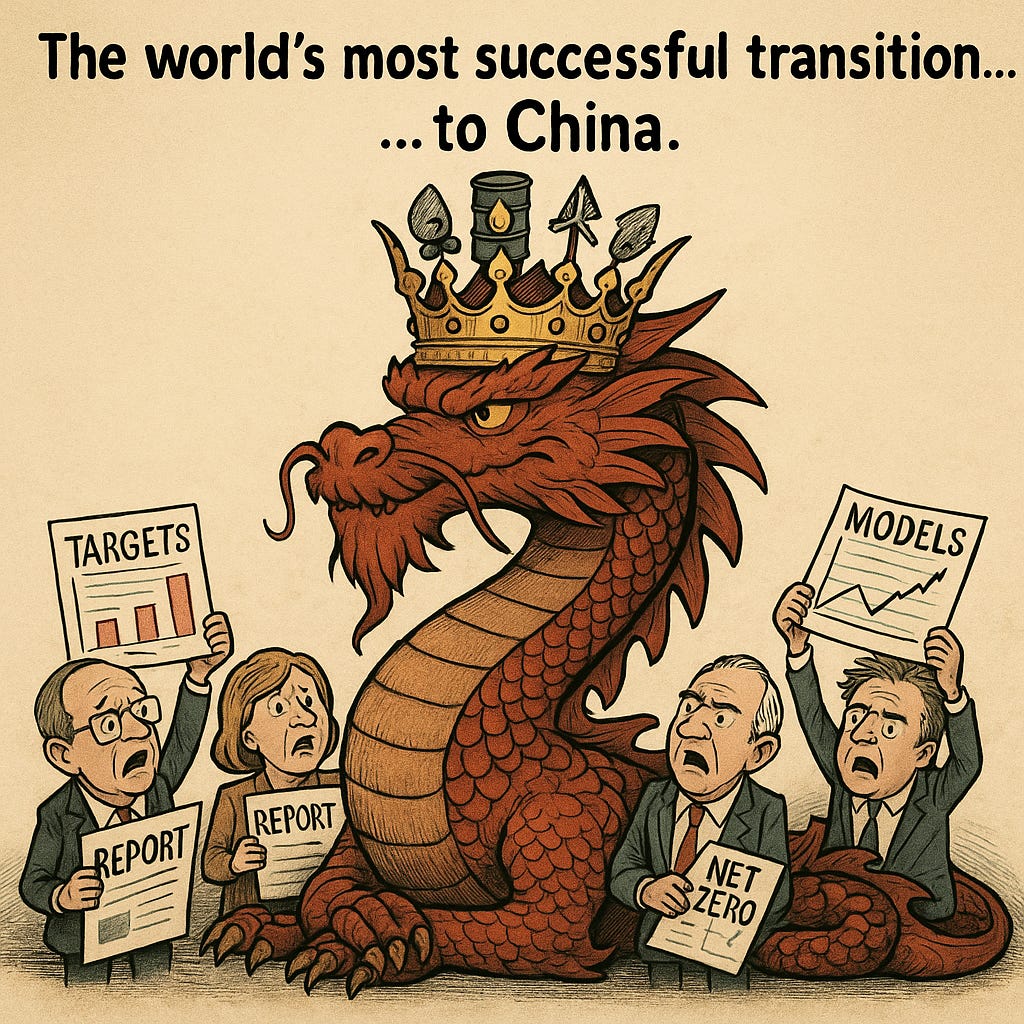
The International Energy Agency once had a reputation for delivering solid data on what fuels the world.
That changed under the leadership of Turkish economist Fatih Birol, who seemed to want the agency to be just another galah in the pet shop talking about climate change. Reports became increasingly framed around the energy transition, and the agency began giving far greater prominence to its Net Zero scenario — a normative pathway that modelled a rapid decline in fossil fuel use. You often had to read deep into the text to discover that coal, oil and gas still supplied more than 80 percent of the world’s primary energy, year in, year out.
But things have changed. Maybe it’s because the world is now laser-focused on energy security and affordability and the agency has had a reality check. Maybe it’s because US Energy Secretary Chris Wright threatened to pull America’s cheque out of the organisation.
Whatever the reason, it is good to see something like a return to normal service in its World Energy Outlook 2025.
The report is broken into three scenarios, which the agency stresses are not forecasts. The first shows what governments are actually doing (Current Policies Scenario). The second reflects what governments say they intend to do, assuming every pledge and policy promise is delivered (Stated Policies Scenario). The third is what would need to happen to reach Net Zero, even though no country is remotely on that trajectory (NZE Scenario).
You don’t even have to read between the lines to find that the agency no longer believes in its own net zero model.
The report says the world is not on track to hit its climate goals and its net zero models are melting down as they strain against physics to stay within the guardrails that allegedly separate manageable warming from catastrophe.
“To meet the near-term emissions benchmarks necessary to avoid substantially exceeding the 1.5 degrees Celsius target, each successive edition of the Net Zero Emissions Scenario has featured more rapid near-term emissions reductions, stretching feasibility to its limits,” the report says.
How could that unfeasible target be hit?
“In the Net Zero Emissions Scenario, global final energy consumption drops by 4 exajoules a year on average over the next decade, with 75 percent of the decline occurring in advanced economies,” the report says.
That cut is the equivalent of erasing roughly two-thirds of Australia’s annual energy use from the globe, and doing it every year for ten years. On this pathway, advanced economies would have to cut their final energy use by roughly one-fifth in a decade. Efficiency gains on this scale have no historical precedent, and slamming on the brakes would trigger depression-level economic trauma. In the real world, net zero by 2050 means smaller economies, deindustrialisation and falling living standards. If this is the plan, it is a blueprint for poverty.
News travels slowly to Australia, so the Albanese Government is enthusiastically on board for destination net zero as many countries are quietly leaving the train. Now both parties in the Liberal/National coalition have effectively dumped the target, it will be fascinating to watch whether they have the political fuel in the tank for this fight. There is no predicting the future, but there is plenty of evidence that they have made the right call and the MPs and Senators should all read the latest IEA Outlook.
Fossil Fuels Still Rule
Start with the most basic metric of all: global energy demand.
The IEA reports that in 2024 the world consumed more than 650 exajoules of energy, an increase of 2% in a single year – far above the long-term average. Nearly 80% of this came from coal, oil and gas. Twenty-five years of climate diplomacy has barely budged the needle.
And demand is not flattening. It is accelerating.
China alone accounts for 56% of global coal use.
Since 2019, coal demand has grown 50% faster than natural gas – the next-fastest fossil fuel.
In the decade to 2024, China was responsible for two-thirds of global oil demand growth and one-third of the increase in gas demand.
Annual global CO₂ emissions hit 38 gigatonnes, a record.
The world has never burned more fossil fuel than it did last year.
This is the opposite of a transition.
It is an addition – piling wind, solar and batteries on top of a fossil-fuelled system that keeps expanding as billions of people seek the prosperity energy enables.
The Great Mirage: Net Zero by 2050

The IEA’s Net Zero scenario (NZE) has become so strained it no longer resembles a plausible pathway.
To stay inside the 1.5°C boundary, the IEA says global final energy use must fall by four exajoules every year for a decade. Three-quarters of that contraction must come from advanced economies.
Translated: Every year, the world must erase the equivalent of two-thirds of Australia’s annual energy use. For ten years straight.
To its credit, the agency concedes the absurdity: “Each successive edition of the Net Zero Emissions Scenario has featured more rapid near-term emissions reductions, stretching feasibility to its limits.”
CPS – Current Policies Scenario
This is the real world where governments do what they already have on the books. Over the last 20 years this scenario is the one that has tracked reality more closely than any other scenario.
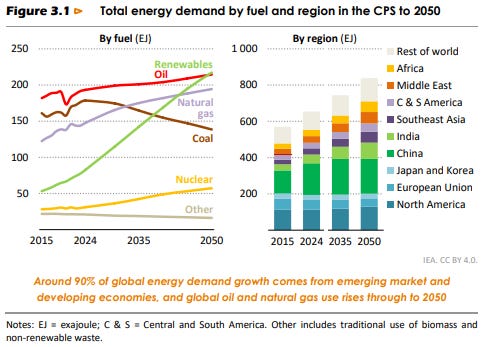
Energy demand rises by 90 EJ by 2035.
Coal remains entrenched in Asia.
Oil and gas keep growing through 2050.
Emissions plateau near current record levels.
Warming reaches 2.9°C by 2100 and keeps rising.
STEPS – Stated Policies Scenario
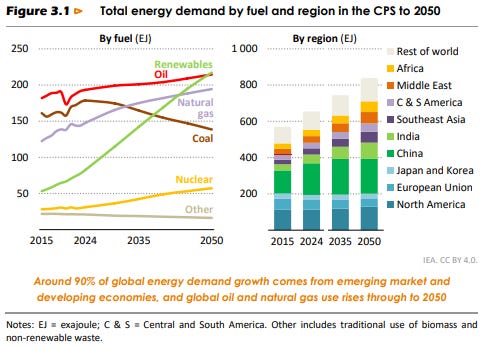
This assumes governments do everything they have promised. History suggests they won’t.
STEPS requires:
efficiency improvements at the high end of global historical experience
rapid electrification of transport and heating
constraints on energy demand
climate-policy discipline across 180 nations
This has never happened at global scale.
The result is modest: emissions fall below 30 Gt by mid-century, but fossil fuels still dominate the system and energy demand keeps rising.
Neither STEPS nor CPS involves a fall in global demand. Neither resembles Net Zero.
The Shape of the New Energy World
The report offers other striking insights that puncture the comforting slogans of the transition:
Data centres will absorb $580 billion in investment this year—more than global oil supply—and the largest sites (200 MW+) consume as much electricity as 200,000 households each. Dublin has frozen new connections until 2028 because the grid cannot cope.
Critical minerals are now a geopolitical fault line. One nation—China—is the dominant refiner for 19 of 20 strategic minerals, with an average market share of 70%. More than half are now subject to export controls.
LNG supply is undergoing a historic expansion: 300 bcm of new capacity by 2030, half of it in the United States, ensuring gas remains central to global energy security.
Nuclear energy is enjoying a revival. More than 40 countries now include nuclear in their national strategies, with investment rising in both large reactors and SMRs.
Electricity prices are moving to the centre of politics. As the IEA puts it:
“Electricity is becoming a defining indicator of energy affordability.”
Bills are rising across most regions as electrification deepens and nations build the grids, storage and redundancy required by weather-dependent systems.
This is the “Age of Electricity,” but not the cheap or simple one governments imagined.
The China Factor
The IEA makes the point implicitly; the data makes it explicit: China dominates the world’s energy system.
It is the largest or second largest consumer of:
coal
oil
gas
hydro
wind and solar
It is the third-largest producer of nuclear energy — with a bullet.
It emits 32% of global CO₂.
It has an effective monopoly over the supply chains of everything labelled “clean”: solar panels, batteries, EV motors, critical minerals and permanent magnets.
According to the German Economic Institute, 150 out of 181 countries now run a merchandise trade deficit with China. This is not a coincidence. It is the direct consequence of the West outsourcing heavy industry to a nation that never pretended to embrace Net Zero discipline.
So the major achievement in a quarter of a century of trying to limit emissions is to shift the point of production. China grew wealthy and powerful as the west outsourced the furnaces of industry. It now consumes 56 percent of the world’s coal. In the decade to 2024 it was responsible for more than two-thirds of global demand growth for oil and one-third of the global increase in demand for natural gas. And in 2024 the world burned more coal, oil and gas in a single year than ever before in human history. China now produces 32 percent of the world’s carbon emissions but that signal of energy abundance helped Beijing secure one third of the globe’s manufacturing.
The energy transition turns out to be a giant ponzi scheme and the net result is rising emissions and a strategically stupid gift of industrial, economic and military power to Beijing.
Brilliant.
The Politics of Pretence
The IEA states the bleeding obvious: “The world is clearly not on track to meet internationally agreed climate goals.”
As of November, countries representing only 55% of global energy-related emissions have submitted new climate pledges. The rest—essentially the entire developing world—has not.
Meanwhile, many advanced economies have legislated ambitions they cannot meet with existing technology or tolerable economic pain.
The Albanese Government has written net zero into its Climate Change Act, but without penalties or enforcement. It is an ambition, not an obligation. Even the 2035 target may not be legislated, suggesting the government has little confidence in meeting it and doesn’t want to be hauled into court to debate a fantasy.
A More Sober Path
Climate change is a problem but, as Microsoft founder Bill Gates, now admits it’s not an existential threat to human civilisation. We should try to cut emissions in a measured way, in step with what the rest of the world is prepared to do. We should not be driven by visions of the apocalypse. One of the world’s best analysts of climate scenarios, Professor Roger Pielke Jr, notes the good news that the dire projections a decade ago, which focused on scenarios of 4 to 6 degrees of warming by 2100, have shifted down to central estimates below 3 degrees. Alas, alarmists have simply rebased the catastrophe threshold and every weather event is now branded “unprecedented” and linked to climate change.
But a measured response is not the same as self-harm. The world is not aligning with net zero, and no amount of modelling will make it so.
A more rational path lies between denial and utopianism:
cut emissions in line with what the world is actually doing
strengthen national energy security
use all available energy sources and focus on keeping energy prices low
avoid outsourcing our prosperity to nations with no intention of cutting theirs
invest in resilience, not fantasies
The IEA has done the world a service by returning to something like normal service. The question is whether politicians will get the message.
An exceptional article Chris. This should be on everyone’s reading list. Especially those who are elected to lead our nation.
Top piece. I particularly liked:
“The energy transition turns out to be a giant ponzi scheme and the net result is rising emissions and a strategically stupid gift of industrial, economic and military power to Beijing.
Brilliant.”
Thinking of PM Morrison’s bizarrely untimely decision to join Australia to the net zero millstone, I am reminded of the repeated tendency for Australia to join an international intellectual fashion just as its stupidity has been realised by those who adapted it first.