


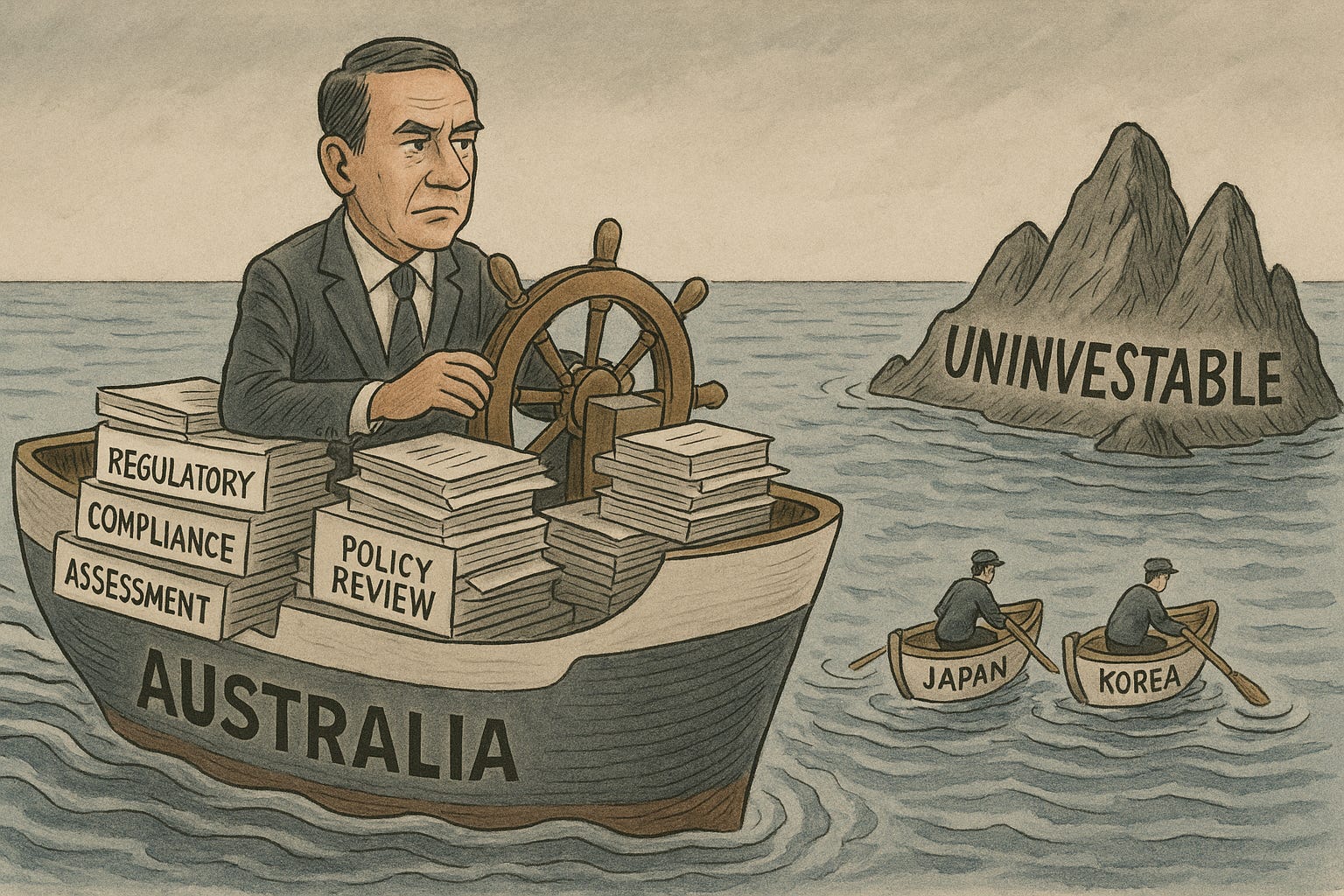
“Many people want the government to protect the consumer. A much more urgent problem is to protect the consumer from the government.” — Milton Friedman
Having spent the last two weeks meeting with senior executives from Japanese and Korean energy giants, the message to Australia is simple: we are sleepwalking into oblivion.
Let us start with the facts. Japan and Korea have been responsible for over $1.1 trillion of export value in coal and liquefied natural gas (LNG) over the past five decades, not to mention over $150 billion in royalties. Australia could be the net beneficiary of far superior outcomes for the coming fifty years, but we appear to be doing everything in our power to prevent this from happening. We are the poster child for economic suicide. Driven by ideology, it is naively assumed we can guilt-trip nations like Japan and Korea to follow our path to impoverishment.
As the former NSW Senior Trade & Investment Commissioner, this is a message I have made patently clear to our federal and state governments for years. Whether coal reservations, arbitrary royalty hikes, or spirit whales killing LNG projects, I have voiced concerns that my dear North Asian friends view our relationship as having drifted away from the foundation of mutual understanding to one based on transaction. As someone who has lived a quarter century in the region, the bilateral relationship with both North Asian nations has never been worse. Forget the kumbaya you may hear from bilateral conferences. There are a herd of elephants in those rooms.
The recently updated Environment Protection and Biodiversity Conservation Act (EPBC) has just put another nail in the coffin of two of our most reliable partners. Put simply, the Act extols the virtues of making it even harder to invest in coal and LNG assets.
Several of these international investors have seen federal Department of Climate Change, Energy, the Environment and Water (DCCEEW) Secretary Mike Kaiser’s LinkedIn post celebrating “securing prosperity.” For someone earning A$930,000 per annum, Mr Kaiser seems not to understand that to “secure prosperity” it is necessary to have satisfied customers. Using hashtags #proudsecretary and #publicserviceisaverb may be a positive way to praise the internal collective, but the private responses of energy giants more closely align with hashtag #Australiaisbecominguninvestable.
The Japanese and Koreans see the addition of ever more onerous regulatory tape as lessening investment attraction against jurisdictions that are cutting the cost of doing business.
Japan and Korea run energy out of their economic development agencies — namely the Ministry of Economy, Trade & Industry (METI) and the Ministry of Trade, Industry & Energy (MOTIE) respectively. Environmental agencies to date have played little part. METI and MOTIE work hand in glove with industrial giants Toyota, Panasonic, Hyundai and Samsung to ensure they can secure cheap, reliable energy that will deliver considerable competitive advantages.
It is no surprise that Japan ranks first place in the Harvard University Economic Complexity Index (ECI). Australia ranks 105th out of 145 nations, behind Yemen, Uganda and Iran. In a decade’s time the index is expected to rank us 137th, presently occupied by Cameroon. The Fraser Research Institute conducts a global survey on mining investment attractiveness. No state makes the top 10, and NSW has fallen from 27th to 62nd over the past five years out of 82 jurisdictions, behind the Democratic Republic of Congo, Ivory Coast and Zimbabwe. Victoria is ranked 63rd.
When a nation lacks natural resources, necessity becomes the mother of invention. Energy security means national security. Despite being so abundantly self-sufficient, our governments appear ambivalent about killing off our second- and third-largest export markets and, with them, our domestic industry.
The unpalatable truth is that the Japanese and Koreans have admitted they have no issue with buying high-quality, cheaper Russian coal as a substitute. Once they switch to long-term, multi-decadal contracts, Australia will struggle to find like markets. It is not as though we have not been warned.
In recent years, Japanese companies have started to raise their frustrations publicly. This year, JERA (LNG) and Idemitsu (coal) made their frustrations about our increasingly difficult-to-navigate policy settings known. We are on notice. Australia needs to recognise our friends have shifted to DEFCON 2 on resources. There are unlikely to be further warnings.
Our government has lost its compass.

An article recently pointed out that over 50% of Australian voters are on the Labor Teat - as bureaucracy, or welfare recipients... which I guess explains our stupidity of voting in and still supporting Labor and Albo, which together must rank as the most anti-Australian, most unpatriotic government and PM in our history.
Someone in the North West Shelf Project told me that the Japanese were pissed off because Australia had told the Japanese to slow down their LNG tankers so they would emit less carbon on their way to Japan. Do you have any more examples of such Australian stupidity? It is good to point out there is a big problem which the Australian public aren't told about. But it would be a great help to compile a list of all the individual stupidities that are concerning Korea and Japan.