


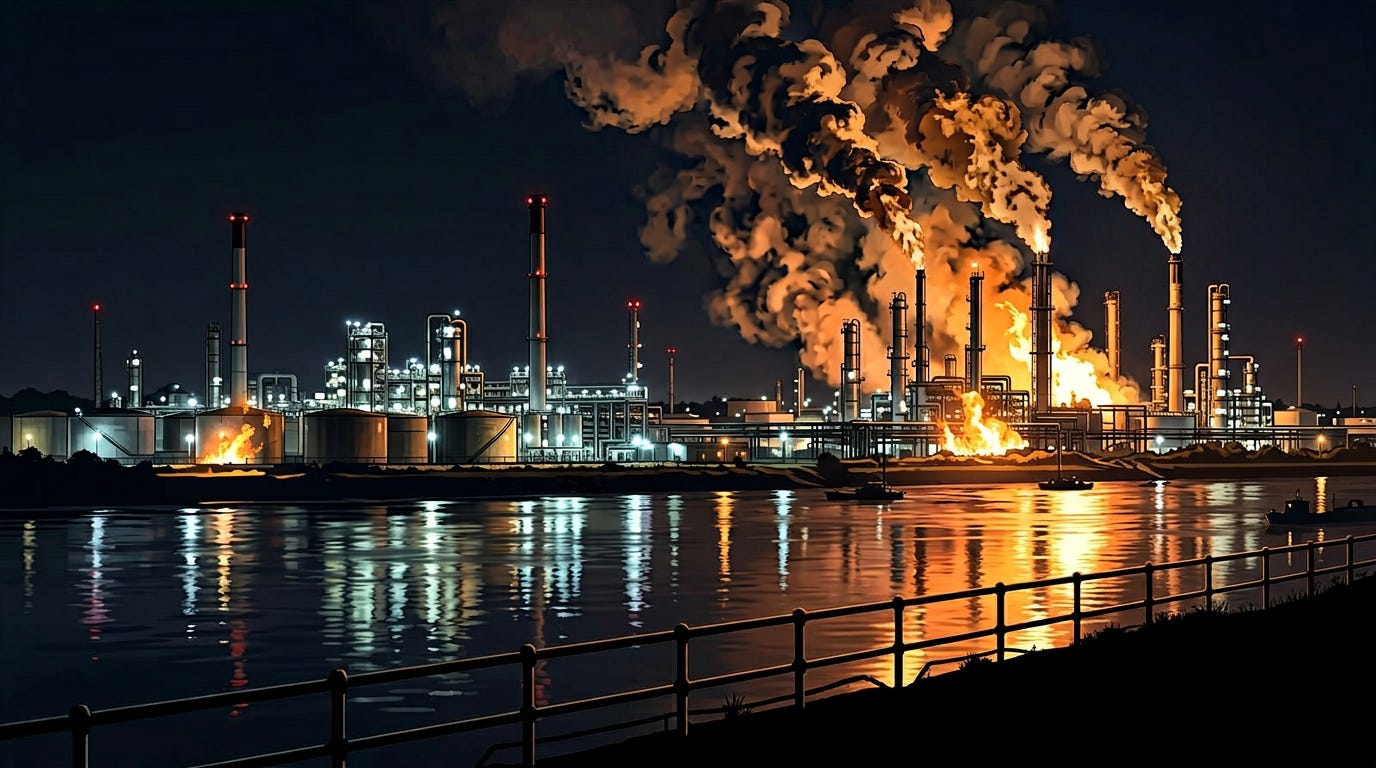
Australia’s fuel woes now come not as single spies but in battalions. The blaze in Geelong at one of our two remaining refineries has deepened the crisis and will make our worldwide scramble to secure liquid fuel even more urgent.
Maybe this is the energy crisis we had to have because the fault lies not in our stars but in ourselves.
The Albanese government, like the rest of the world, is collateral damage in the third Gulf war but it bears its share of responsibility as one in a long line of administrations that presided over a two-decade decline in our fuel security.
We have drifted to a point where we are petrol, diesel and jet fuel mendicants, despite being one of the biggest per capita consumers of liquid fuels on Earth. We all but gave up searching for oil, surrendered our refining capacity and assumed just-in-time supply chains would endure. We were always destined to reach a moment when our luck ran out.
What matters now is whether we can develop a robust plan to secure energy sovereignty based on the fuels that actually run the nation. If not, we will remain hostage to the next shock. There will be another and it may well be worse as the pieces are already in motion.
Australia’s dependence on imported refined fuels ties our fate to the stability of increasingly contested sea lanes.
While the third Gulf war burns an indelible image of the Strait of Hormuz into the world’s consciousness, there are other physical and political choke points that should be keeping our leaders awake at night.
Beijing has returned to island building in the South China Sea for the first time since 2017. Once again, it is reshaping the map by turning a remote atoll into what could become its largest military base in the region.
The Paracel Islands are a scattered chain of low-lying reefs and islets about halfway between Vietnam and China’s southern coast. Beijing seized them during the Vietnam War.
From space, one dot on the map, Antelope Reef, resembles a polished blue agate, a ring of pale sand encircling a deep indigo core.
Satellite images taken between mid-December last year and early March show construction moving at an astonishing pace.
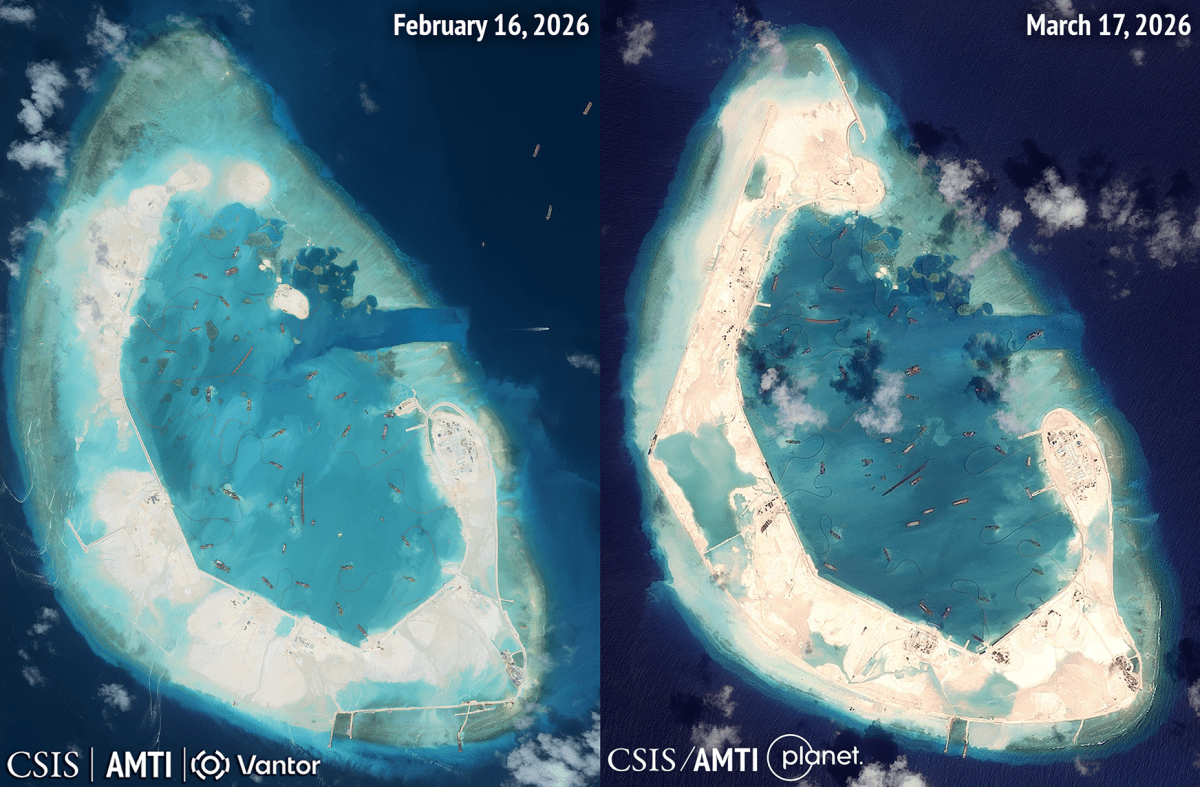
Dredgers carved a channel through the cay, piled up sand on the coral rim to make an artificial island, and soon jetties, a helipad and clusters of buildings appeared.
Analysis from the Asia Maritime Transparency Initiative shows 600ha already reclaimed, putting Antelope almost level with Mischief Reef, China’s largest outpost in the South China Sea. It can now support a 2700m runway, long enough for all of China’s advanced fighter jets. A similar runway on Woody Island already hosts nuclear-capable bombers.
The enlarged lagoon also could shelter a flotilla of coastguard ships and militia fishing boats trained to support military operations, giving Beijing a persistent presence in surrounding waters. It would be large enough to house missile systems and surveillance arrays and electronic warfare equipment.
About 1000km southeast lies Scarborough Shoal, a coral atoll entirely within the Philippines’ 200-nautical-mile exclusive economic zone. China has maintained de facto control there since 2012, blocking Philippine access to its inner lagoon despite a 2016 international tribunal ruling that found its claims unlawful.
China has not built an island there but it has not needed to. Control is enforced from the water, not the land.
On April 15, shipping data firm Kpler tracked 528 Chinese-flagged vessels operating across these disputed waters. Kpler says Scarborough is the most visible pressure point in the South China Sea, but its data shows a wider pattern: a layered deployment of Chinese vessels asserting control without triggering open conflict.
Those vessels are pushing ever farther south, within a few hundred kilometres of Indonesia and towards the approaches to the world’s most important shipping lane, the Strait of Malacca. This narrow channel between Malaysia and Indonesia carries about 440 commercial vessels a day. Any disruption, even short of a blockade, would tear through global energy and freight markets.
Kpler says there is no immediate threat to the Malacca Strait but the risk is steadily rising. What Beijing reveals in places such as Scarborough Shoal is a method: persistent presence, incremental pressure and the gradual normalisation of coercion at sea.
“The relevance of the Scarborough developments, and the fleet density the vessel data reveals, is less about immediate supply disruptions and more about trajectory,” Kpler notes.
“The threshold for maritime coercion appears to be shifting, gradually but consistently.
“This aligns with the broader view that the current geopolitical environment is defined less by sudden conflict and more by prolonged, structural competition between major powers. For markets the risk is not a single shock event but a steady accumulation of frictions that make critical arteries like Malacca feel less unquestionably secure over time.
“For now, flows through Malacca remain uninterrupted. But as choke-point risk continues to reprice globally, from Hormuz to the Red Sea, the South China Sea is increasingly part of that same conversation. Scarborough Shoal may be a localised dispute, but the tactics being tested there, and the fleet density the data reveals, are anything but local.”
There are a couple of other choke points that countries such as Australia need to factor into its plan for energy sovereignty. The first is already evident, as Beijing moved to prioritise domestic demand over supplying other markets with fuel shortly after the third Gulf war began. Anthony Albanese has called Chinese Premier Li Qiang to discuss energy security but there is little sign it had any effect.
China was a major supplier of jet fuel to Australia, but the last shipment from there departed on March 13. Given the forward booking of these cargoes, it appears China has not honoured existing contracts with Australia, still less offered to help in this crisis. In the Prime Minister’s shuttle fuel diplomacy Beijing has yet to appear on the flight schedule.
Beijing knows energy is power. It is supplying fuel to The Philippines and Vietnam, but only in small, selective shipments. It is not acting as a trading partner but as a gatekeeper.
There is one last choke point, and it is the hardest to clear because it is in the mind: the grim determination of Albanese government ministers to sell a mirage of the swift electrification of everything.
Transport Minister Catherine King declared this week that the world had moved on from drilling for oil in the search for fuel security, saying: “We talk about the need for electrification as part of the energy security, it’s also part of our economic security.”
If King consulted a work produced by her own department, she would have a better handle on how far we have moved on from petrol and diesel. According to the latest edition of Road Vehicles Australia this nation had 22.3 million registered vehicles in January 2025, of which 259,690 are electric, or just over 1 per cent of the total fleet. Most of that is in passenger vehicles, where there are 249,430 electric cars out of 16.08 million, or roughly 1.6 per cent. In the heavy and commercial fleet, electric vehicles number only in the low thousands out of more than five million vehicles; in percentage terms EVs are a rounding error. This does not count all the off-road vehicles working in mines and agriculture.
There was a flurry of breathless stories recently about the surge in the sale of EVs in March so this column called Federal Chamber of Automotive Industries chief executive Tony Weber to sift the statistics.
“March 2026 was the best month ever recorded for EVs in Australia, with 15,839 sales, or 14.6 per cent of the market,” Weber says. “The other 85 per cent of sales are using either petrol or diesel as part of their propulsion. Given there are around 20 million light vehicles on the roads in Australia, it is clear that we will rely on diesel and petrol supply for decades to drive our fleet.”
This electric salvation day buried somewhere over the rainbow also jars with the sight of a Prime Minister burning jet fuel in a race around the region bartering for liquid fuel from our neighbours with the promise of delivering gas and coal. And did anyone hear Albanese trumpet the promise of Sun Cable delivering solar power from the Northern Territory to Singapore when he dropped in to meet with his counterpart Lawrence Wong? Forgive me if I missed it.
The road to a new energy future will be long. EVs will have their place but the power that moves this nation now and in the foreseeable future is liquid. Until we face that reality, we will remain what we have become, supplicants for the fuels we once made ourselves.
As Shakespeare warned, “Our remedies oft in ourselves do lie.” The question is whether we still have the wit and will to find them.
Thanks for another insightful article, Chris. So much about which to be concerned, but this single statement really blew my mind: “China was a major supplier of jet fuel to Australia,” How and why such an energy rich country like Australia allowed itself to get into this position beggars belief. Australia’s leaders have been beyond incompetent when it comes to energy security, they’ve been criminally negligent. Almost suicidal. How utterly humiliating that Albo had to crawl on his knees to Malaysia, Singapore, et al for emergency energy assistance when Australia should and could be leading the way for the region. Utterly reprehensible.
Our government are just a mob of ballot box twits. We have runaway NDIS expenditure whilst the whole commonwealth is in grave danger. The thing about defense is it is important, very important. The way we are going we risk losing everything.
Meanwhile Albanese and the dickheads surrounding him worry about the ethnic vote, solar power and not offending NDIS rip-off fat cats. Just disgraceful.